
Table of Contents
- Why Most Christians Struggle to Apply Biblical Wisdom Consistently
- The Difference Between Wisdom and Information
- What Proverbs Actually Teaches
- The Fear of the Lord: The Foundation of Biblical Wisdom
- Biblical Stewardship vs. Worldly Wealth
- Why Reading Proverbs Alone Is Not Enough
- Why Most Financial Advice Ignores Behavior
- How Proverbs Changes Financial Habits
- The Step-by-Step Proverbs System
- Daily Proverbs Study Examples
- How Proverbs Applies to Relationships and Work
- How Proverbs Builds Long-Term Discipline
- Why Systems Matter More Than Motivation
- Common Mistakes Christians Make
- Related Teachings Worth Exploring
- A Structured System for Applying Biblical Wisdom
- Final Thoughts
- About the Author
- FAQs
Most people do not struggle because they lack information. They struggle because what they know never becomes what they consistently do.
Many Christians already understand the basic principles: wisdom, stewardship, discipline, patience, diligence, integrity. The problem is that understanding rarely translates into structured daily behavior on its own. People read Scripture, feel a moment of conviction, and then return to the same patterns: emotional spending, inconsistent discipline, poor stewardship, impulsive decisions, and the financial stress that follows.
That gap between knowing and doing is what this system is designed to close. The goal is not more biblical knowledge. The goal is applying biblical wisdom repeatedly until it begins shaping habits, decisions, stewardship, and long-term financial direction. That is precisely what Proverbs was written to produce.
Why Most Christians Struggle to Apply Biblical Wisdom Consistently
The most common approach to biblical growth is emotional rather than systematic. People rely on inspiration, seasonal motivation, and occasional conviction to drive change. When those feelings fade, which they always do, the behavior reverts.
Proverbs teaches something fundamentally different. It emphasizes consistency, discipline, correction, diligence, and long-term thinking over intensity or emotional momentum. Most lasting transformation does not happen through dramatic moments of breakthrough. It happens through repeated daily decisions made in ordinary circumstances.
This is especially true financially. Financial instability is almost always behavioral before it is mathematical. People spend emotionally, avoid planning, react impulsively, and fail to steward consistently, then go looking for a financial solution while the underlying wisdom problem goes unaddressed. Proverbs identifies the root issue directly: the problem is not the absence of information. It is the absence of consistent, structured application.
That is why structure matters more than motivation.
The Difference Between Wisdom and Information
This distinction is worth slowing down on because most people miss it entirely.
Information is knowing that impulsive spending creates financial instability. Wisdom is consistently choosing not to spend impulsively, even when the urge is strong, because you understand where that pattern leads over time. Information sits in your mind. Wisdom shapes your behavior.
Proverbs is not a book of facts to be memorized. It is a book of principles to be practiced. The writer of Proverbs understood that knowing what is right and doing what is right are two entirely different disciplines. That is why the book returns to the same themes repeatedly: discipline, correction, diligence, and patience. Repetition is not redundancy. It is the mechanism of formation.
This matters practically because many people treat Bible study as an information-gathering exercise. They read, they highlight, they feel informed, and they move on unchanged. Biblical wisdom works differently. It is designed to be absorbed slowly, connected to real circumstances, and applied consistently until it reshapes the patterns driving behavior. That process takes time, and it requires a structure that supports repetition rather than occasional engagement.
The gap most people experience is not a knowledge gap. It is an application gap. Closing it requires a different approach entirely.
What Proverbs Actually Teaches
Many people approach Proverbs as a loosely connected collection of inspirational sayings. That misreads what the book is doing.
Proverbs is a highly practical framework for daily living. Its central message is consistent throughout: wisdom produces life, stability, discipline, and long-term blessing, while foolishness produces instability, regret, and destruction. That contrast appears repeatedly in different forms: wise versus foolish, diligent versus lazy, disciplined versus impulsive, humble versus prideful, patient versus reckless.
The book addresses discipline, stewardship, planning, habits, diligence, speech, relationships, integrity, work ethic, and financial behavior with direct, specific instruction. It is not abstract moral guidance. It is operational wisdom for the decisions people face every day.
This is why Proverbs remains as relevant now as it has ever been. Human behavior has not changed. People still struggle with impulsiveness, greed, laziness, emotional decision-making, and poor stewardship. Proverbs addresses those patterns directly and without apology.
The Fear of the Lord: The Foundation of Biblical Wisdom
Proverbs establishes its foundational principle immediately in the first chapter:
"The fear of the Lord is the beginning of knowledge." (Proverbs 1:7)
This is not a reference to terror or dread. It refers to reverence, humility, and a genuine willingness to submit to God's wisdom rather than defaulting to personal impulse, pride, or short-term thinking.
This matters because Proverbs treats wisdom as inseparable from alignment with God's instruction. Many people pursue financial stability, discipline, and better decisions while simultaneously rejecting the biblical framework that produces them. Proverbs shows consistently where that leads: shortcuts justified through pride, foolish decisions rationalized in the moment, correction avoided until consequences become unavoidable.
The foundation is not a suggestion. Without it, the rest of what Proverbs teaches gets selectively applied in ways that miss the point entirely.
Biblical Stewardship vs. Worldly Wealth
One of the most important distinctions Proverbs draws is between the pursuit of wealth as an end in itself and the practice of stewardship as a responsibility. These are not the same thing, and confusing them produces predictable problems.
Worldly wealth culture is built on accumulation, comparison, and status. The underlying assumption is that more is always better, that financial success is the goal, and that the measure of wisdom is how much you have. Proverbs consistently pushes back against that framework. It does not condemn wealth. It condemns the love of money, the shortcuts that compromise integrity, and the instability that follows undisciplined financial behavior.
Biblical stewardship operates from a different premise entirely. It treats resources as entrusted rather than owned, and it measures success not by accumulation but by faithful management of what has been provided. Proverbs 27:23 captures this directly: know the condition of your flocks, give careful attention to your herds. The instruction is not to pursue more. It is to manage well what you already have.
This reframing matters enormously for financial behavior. A stewardship mindset asks different questions than a wealth-accumulation mindset. Instead of "how do I get more?", it asks "how do I manage this faithfully?" That shift in orientation tends to produce more disciplined spending, more intentional planning, and greater long-term stability than the pursuit of financial success ever does on its own.
The world offers countless strategies for building wealth. Very few of them address the behavioral and character foundations that determine whether wealth, once built, is sustained or squandered. Proverbs addresses those foundations directly.
Why Reading Proverbs Alone Is Not Enough
Many Christians read Proverbs with some regularity and still experience no lasting change. The reason is straightforward: reading alone rarely changes behavior.
Transformation requires application, repetition, correction, discipline, and consistency over time. Most people make the mistake of consuming biblical wisdom without implementing it. They know debt is dangerous. They know impulsive spending causes problems. They know stewardship matters. Yet they continue operating emotionally because knowledge never became structured practice.
This is one of the clearest patterns in financial struggle as well. The information is not missing. The system for turning that information into consistent daily behavior is what is missing. That is what a repeatable framework solves.
Why Most Financial Advice Ignores Behavior
Most conventional financial advice focuses on strategy: budgeting methods, investment vehicles, debt payoff systems, income growth tactics. These are useful tools. But they operate at the surface level of a much deeper problem.
Financial behavior is not primarily a math problem. It is a character and habit problem. A person can understand a budget perfectly and still spend impulsively. A person can know that debt is expensive and still accumulate it. A person can have access to every financial strategy available and still make emotionally driven decisions that undermine all of them.
This is why so much financial advice produces temporary improvement followed by regression. The strategy changes but the underlying behavior does not. Without addressing what drives the behavior, no system holds for long.
Proverbs operates at the level most financial advice never reaches. It addresses the internal patterns: impulsiveness, greed, comparison, pride, laziness, and lack of self-control, that produce financial instability in the first place. It does not offer a five-step plan for getting rich. It offers something more foundational: a framework for developing the character and discipline that make sound financial decisions sustainable over a lifetime.
That is why applying biblical wisdom to finances produces a different kind of result than applying a financial strategy alone. The strategy without the character tends to fail. The character, once developed, tends to make most sound strategies work.
How Proverbs Changes Financial Habits
Financial habits do not change because someone decides to change them. They change because the internal patterns driving them change first. This is where Proverbs does its most important work.
Consider impulsive spending. At the surface level, it looks like a budgeting failure. Look deeper and it is almost always driven by something emotional: the desire for relief, comparison with others, the need for status, or simply the habit of reaching for immediate satisfaction when delayed gratification would serve better. Proverbs addresses all of these at the root. It warns repeatedly against envy, pride, impulsiveness, and the instability they produce. It emphasizes contentment, patience, diligence, and long-term thinking as the alternative.
When those principles are applied consistently, the behavior begins to shift. Not because of willpower alone, but because the framework for evaluating decisions has changed. A person who has genuinely internalized Proverbs 13:11, that wealth gathered little by little increases while hastily gained wealth dwindles, approaches a financial decision differently than someone operating purely on emotion or impulse.
This is also why the daily system matters. Financial habits are not changed through occasional reflection. They are changed through repeated, deliberate practice over time. Reading a chapter of Proverbs daily, identifying a principle, and applying it to a specific financial behavior creates the kind of sustained engagement that gradually reshapes default patterns. Small consistent actions, repeated over months and years, produce outcomes that no single dramatic decision ever could.
The Step-by-Step Proverbs System
Simple systems are the ones people actually sustain. This framework works because it is structured, practical, repeatable, and realistic. Since Proverbs contains 31 chapters, the natural approach is one chapter per day aligned to the calendar date. But the chapter is just the starting point. The key is what happens after you read it.
Step 1: Read One Chapter Daily
Read slowly and intentionally. Look for repeated themes, warnings, wisdom patterns, behavioral instruction, and financial principles. The goal is not to complete the chapter. The goal is to understand it well enough to apply something from it today.
Step 2: Identify One Core Principle
Do not attempt to apply the entire chapter at once. That approach collapses quickly. Choose one principle that stands out and is directly relevant to where you are right now: discipline, diligence, patience, stewardship, self-control, wise planning, guarding influences. Focused implementation produces more lasting change than scattered effort.
Step 3: Connect the Principle to Real Life
Ask specific questions: What behavior needs correction? What financial habit lacks discipline? Where am I acting emotionally instead of wisely? What decision in front of me requires more careful thought? This is where biblical wisdom becomes operational. Without this step, Scripture remains theoretical, and theoretical knowledge changes nothing.
Step 4: Take One Measurable Action
Make the application concrete. Create a budget. Track your spending today. Avoid an emotional purchase. Plan tomorrow before it arrives. Limit a distraction that is costing you more than you realize. Small repeated actions compound over time, and that principle appears throughout Proverbs directly.
Step 5: Repeat Daily
Consistency matters more than intensity. Proverbs 13:11 makes this explicit: whoever gathers little by little will increase. That principle extends well beyond finances. Wisdom compounds gradually through repetition, and so does every habit and discipline built around it.
Daily Proverbs Study Examples
Understanding the framework is useful. Seeing it applied to specific chapters makes it practical. Here are three examples of how a daily Proverbs study actually works in practice.
Day 10 (Proverbs 10)
Proverbs 10 contrasts the diligent and the lazy directly: "A slack hand causes poverty, but the hand of the diligent makes rich." The principle for the day is diligence. The practical question: where am I avoiding effort that I know needs to be applied? The measurable action: identify one task that has been postponed due to avoidance and complete it today. Applied financially: review a budget category that has been ignored and bring it current.
Day 21 (Proverbs 21)
Proverbs 21:5 states that the plans of the diligent lead to abundance, while haste leads to poverty. The principle is planning. The practical question: where am I making decisions reactively instead of intentionally? The measurable action: write out a specific financial plan for the next thirty days, even a simple one. One planned decision made in advance is worth ten reactive ones made under pressure.
Day 22 (Proverbs 22)
Proverbs 22:7 states that the borrower is servant to the lender. The principle is debt awareness. The practical question: where is debt currently limiting my options or creating pressure? The measurable action: list current debt obligations clearly, identify the one creating the most pressure, and make one decision today that moves toward reducing it.
These examples are not complex. That is the point. The value of the system is not in the sophistication of each day's application. It is in the accumulation of consistent, deliberate practice over weeks, months, and years.
How Proverbs Applies to Relationships and Work
Biblical wisdom is not limited to financial decisions. Proverbs addresses relationships and work with the same directness it brings to money, and the principles connect in ways that matter practically.
Relationships
Proverbs has significant instruction about who you allow to influence you. Proverbs 13:20 states that whoever walks with the wise becomes wise, but the companion of fools suffers harm. This is not abstract spiritual advice. It is a practical observation about how influence works. The people you spend the most time with shape how you think, what you normalize, and what decisions feel reasonable to you.
Applied practically: if your closest relationships normalize financial impulsiveness, chronic debt, or poor stewardship, those patterns will feel normal to you as well. If your relationships include people who practice discipline, long-term thinking, and sound stewardship, those patterns become your reference point instead. Guarding your relational influences is not isolation. It is wisdom.
Proverbs also addresses conflict, pride, and the damage caused by unchecked speech in relationships. Proverbs 15:1 teaches that a gentle answer turns away wrath. Proverbs 16:18 warns that pride precedes destruction. These principles affect relational health directly, and relational instability carries real financial consequences: broken partnerships, family conflict over money, and the emotional drain that makes disciplined decision-making harder.
Work
Proverbs is unambiguous about the connection between diligent work and long-term increase. Proverbs 10:4 states that a slack hand causes poverty while the hand of the diligent makes rich. Proverbs 12:11 teaches that whoever works his land will have plenty of bread, while whoever chases fantasies lacks sense.
The application is direct: consistent, diligent effort in your work produces more reliable long-term results than chasing shortcuts, trends, or opportunities that promise fast returns. This does not mean refusing growth or avoiding opportunity. It means evaluating opportunities through the lens of wisdom, integrity, and long-term consequence rather than immediate excitement or potential gain.
Proverbs also addresses integrity in work directly. Dishonest gain is condemned repeatedly throughout the book. The message is consistent: shortcuts that compromise character tend to produce instability, while diligent, honest work tends to produce something that holds.
How Proverbs Builds Long-Term Discipline
Discipline is not a personality trait. It is a practiced skill, and Proverbs treats it that way throughout.
The book does not assume that discipline comes naturally or that motivation is a reliable foundation for it. Instead, it consistently describes discipline as something developed through correction, repetition, and sustained practice over time. Proverbs 12:1 states that whoever loves discipline loves knowledge, but whoever hates correction is stupid. That is direct language, and it makes the point clearly: growth requires the willingness to be corrected, not just the desire to improve.
Long-term discipline is built through the accumulation of small, repeated decisions. This is one of the most practical insights Proverbs offers, and it runs directly against the way most people think about change. Most people want to make one significant decision that produces lasting results. Proverbs teaches that lasting results come from many small decisions made consistently over time.
Applied to finances, this means that the discipline of tracking spending daily, reviewing financial priorities weekly, avoiding emotional purchases consistently, and planning intentionally before each month begins are not minor habits. They are the actual mechanism of long-term financial stability. Each individual action feels small. The cumulative effect over years is substantial.
This is also why the daily Proverbs system works as a discipline-building tool beyond its direct content. The act of reading one chapter, identifying one principle, and applying one action every day builds the habit of intentional reflection and deliberate practice. That habit, once established, transfers to every other area of life it is applied to.
Why Systems Matter More Than Motivation
Waiting to feel motivated is a losing strategy. Motivation rises and falls based on circumstances, energy, and emotion. A system operates regardless of how you feel on a given day.
That is one of the core reasons this Proverbs framework is effective. It removes dependence on emotional readiness. Instead of asking "How do I feel today?", the system asks "What principle will I apply today?" That shift is more significant than it sounds. Successful stewardship depends far more on consistency than on intensity, and a system is what makes consistency possible over the long term.
Motivation is useful for starting. It is not reliable for sustaining. Systems sustain what motivation initiates. The goal is to build a structure that produces consistent behavior regardless of whether you feel inspired on any given morning. That is what Proverbs, applied daily through a repeatable framework, actually builds over time.
Common Mistakes Christians Make
1. Reading Without Applying
Information alone does not produce transformation. Application does. These are not the same thing, and treating them as equivalent is the most common reason biblical wisdom stays theoretical.
2. Treating Proverbs as Inspiration Rather Than Instruction
Proverbs is not primarily a motivational text. It is practical behavioral wisdom designed to shape conduct through repeated application.
3. Separating Faith From Financial Stewardship
Scripture consistently connects wisdom to money, stewardship, discipline, diligence, and planning. Treating these as separate from spiritual life misses a significant portion of what Proverbs is actually teaching.
4. Pursuing Quick Fixes Instead of Consistency
Proverbs returns to gradual, disciplined growth repeatedly throughout the book. Shortcuts tend to produce the instability they were meant to avoid.
5. Underestimating the Role of Influence
The people, content, and environments you allow regular access to your thinking shape your decisions more than most people realize. Proverbs takes this seriously. Most people do not.
Related Teachings Worth Exploring
Several passages reinforce these principles directly:
- Proverbs 13:11 on disciplined long-term growth
- Proverbs 21:5 on diligent planning and its outcomes
- Proverbs 4:23 on guarding the internal condition that drives all behavior
- Proverbs 3:5–6 on trusting God's wisdom over self-reliance
You can go deeper with these related articles:
- Proverbs 13:11 Explained: The Biblical Truth About Building Wealth
- Proverbs 4:23 Explained: Why Guarding Your Heart Matters
- Proverbs 3:5–6 Explained: What It Really Means to Trust God
- How to Apply Proverbs to Your Life (A Simple Daily System That Works)
- Proverbs for the Day: How to Apply One Chapter Daily
- What Is the Main Message of Proverbs? (And How to Apply It)
Together, these teachings form a coherent framework for applying biblical wisdom consistently across every area of daily life.
A Structured System for Applying Biblical Wisdom
Most people do not need more information. They need a repeatable framework that turns what they already know into consistent daily practice.
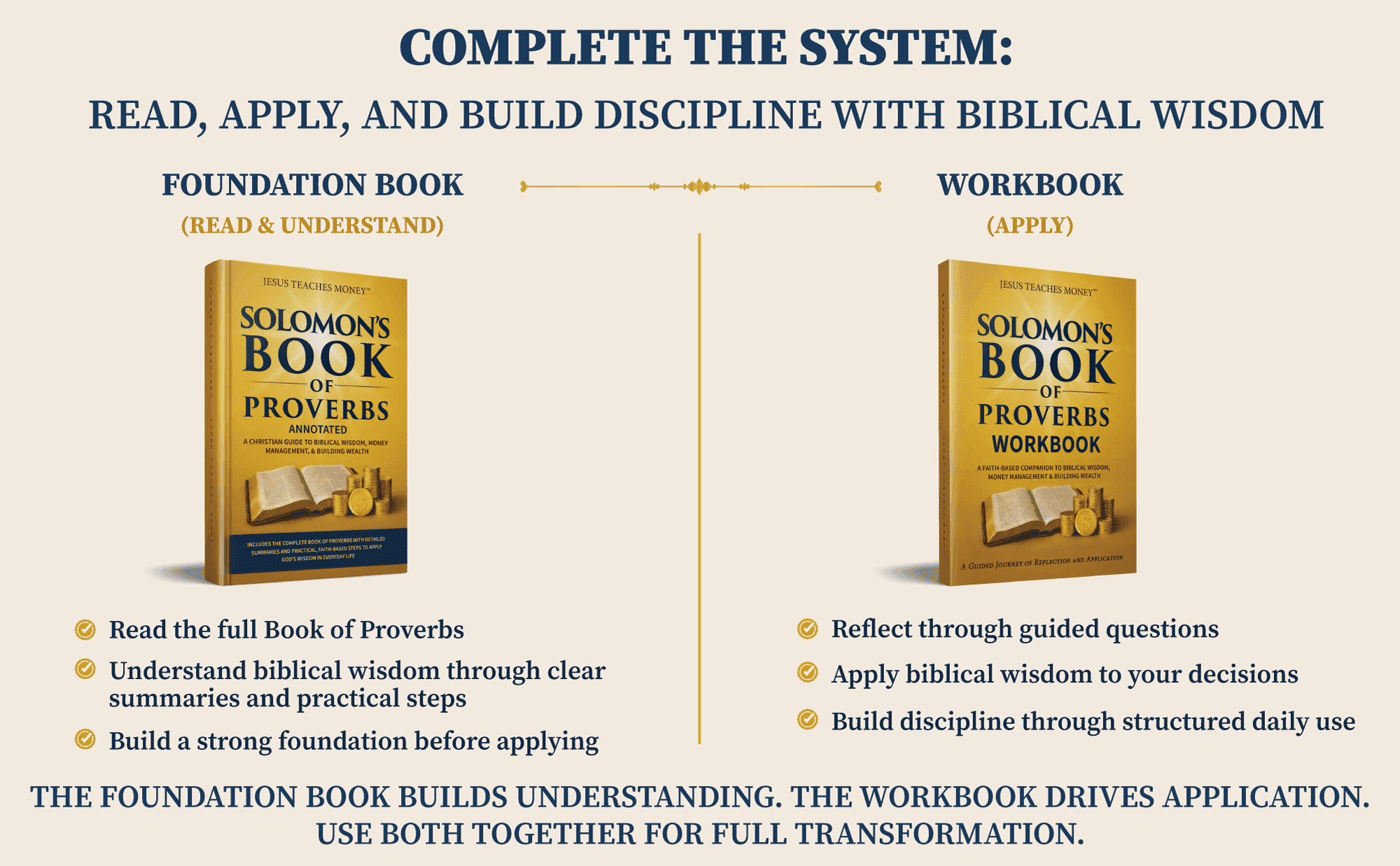
That is the purpose of the Jesus Teaches Money™ Proverbs Study System. It was built to help Christians study one chapter of Proverbs daily, identify practical wisdom principles, apply biblical instruction consistently, strengthen stewardship, improve financial discipline, and build the kind of habits that produce real long-term change.
The goal is not temporary inspiration. It is consistent application, practiced daily, until wisdom becomes the default way you approach decisions, money, relationships, and work.
👉 Explore the 31-Day Proverbs Wealth System
Final Thoughts
Biblical wisdom was never designed to remain theoretical. Proverbs was written to shape habits, discipline, stewardship, and long-term direction through consistent, repeated application. The gap most people experience is not a lack of knowledge. It is the absence of a structure that turns knowledge into practice. When wisdom becomes a daily discipline rather than an occasional source of inspiration, real and lasting transformation begins to occur. That is what this system is designed to produce.
About the Author
Abraham Duncan is the author of Solomon's Book of Proverbs (Annotated) and the creator of the Jesus Teaches Money™ framework, a structured system designed to help Christians apply biblical wisdom to daily life, stewardship, and financial decision-making.
FAQs
How do I start applying biblical wisdom to my finances if I have never done it before?
Start with one chapter of Proverbs aligned to today's date. Read it slowly, identify one principle that connects directly to your current financial situation, and take one specific action based on it. Do not try to overhaul everything at once. One principle applied consistently produces more lasting change than ten principles applied sporadically.
Is Proverbs really practical enough to help with modern financial problems?
Yes, and the reason is straightforward. Proverbs does not primarily address financial strategies. It addresses the behavioral patterns that drive financial outcomes: impulsiveness, lack of discipline, poor planning, greed, and inconsistency. Those patterns have not changed. The financial environment has. The human behavior producing instability within it has not.
What is the difference between reading Proverbs devotionally and studying it as a financial wisdom system?
Devotional reading draws encouragement and spiritual reflection from the text. Studying Proverbs as a wisdom system means reading with the specific intention of identifying behavioral principles and connecting them to real decisions, habits, and financial patterns. The content is the same. The intention and application are different, and that difference determines whether anything actually changes.
How long does it take to see real change from applying Proverbs consistently?
That depends on the area being addressed and how consistently the system is applied. Most people begin noticing shifts in their decision-making patterns within the first thirty to sixty days of consistent daily application. Deeper financial and behavioral change typically develops over several months. Proverbs itself teaches that meaningful growth is gradual. Expecting dramatic results within a week misunderstands how the system works.
Can this system help even if my financial problems feel too large to fix with a daily reading habit?
Yes, and here is why. Large financial problems are almost always the accumulated result of repeated small decisions made without wisdom or discipline. Reversing that trajectory does not require one large solution. It requires consistently better small decisions made over time. The daily Proverbs system addresses the patterns producing the problem, not just the surface symptoms. That is where lasting change begins.