
Table of Contents
- Direct Answer
- Why Most People Never Apply Proverbs Consistently
- What Proverbs Is Actually Designed to Do
- Why a Daily System Works Better Than Random Reading
- How to Apply Proverbs to Your Life: A Practical Daily Framework
- How Proverbs Applies to Money and Stewardship
- Common Mistakes People Make When Studying Proverbs
- Related Biblical Principles
- A Practical Next Step
- Apply Biblical Wisdom Consistently
- Final Thoughts
- About the Author
- FAQs
Direct Answer
Learning how to apply Proverbs to your life requires more than reading a chapter occasionally when you need encouragement. Proverbs was written to shape daily decisions, habits, discipline, stewardship, and long-term direction through consistent, intentional practice. The most effective approach is to study it systematically, identify one principle at a time, and build the discipline to apply it in real life, every day.
Why Most People Never Apply Proverbs Consistently
Most Christians have read Proverbs at some point. Far fewer have developed a practical system for applying it consistently. That gap is the problem.
Knowledge without application rarely produces transformation. It produces familiarity, and familiarity is not the same thing as change.
The pattern is common: read quickly, feel encouraged briefly, move on, forget most of it by the following week. The content was absorbed passively, never connected to a specific decision, habit, or behavior that actually needed to shift. As a result, Proverbs functions as inspirational reading rather than what it was actually designed to be.
Proverbs was written to shape how a person thinks, works, spends, speaks, plans, responds to pressure, manages discipline, and stewards resources. It is behavioral formation literature, not a devotional. The distinction matters because it changes how you approach it.
The issue for most people is not lack of information. They have read the verses. They know the principles intellectually. The issue is the absence of a structure that turns understanding into consistent practice. That is exactly what a daily system provides.
What Proverbs Is Actually Designed to Do
Proverbs is one of the most practical books in Scripture. It addresses discipline, laziness, money, self-control, planning, stewardship, relationships, speech, diligence, and long-term thinking with direct, specific instruction. It is far less concerned with emotional inspiration than it is with behavioral formation.
That distinction is important. Many people approach Scripture passively, reading for comfort or motivation without asking the harder questions: What should change? What action should I take? What habit needs correction? Where am I ignoring what I already know to be true?
Proverbs consistently pushes wisdom into action. Proverbs 13:11 is not a reflection on the beauty of patience; it is an instruction about how wealth is built. Proverbs 21:5 is not abstract encouragement; it is a direct statement about what diligent planning produces. Proverbs 4:23 addresses what governs your decisions at the source. Proverbs 3:5–6 challenges the default of self-reliance.
These are operational principles. They are meant to be applied to daily life, not admired from a distance.
Why a Daily System Works Better Than Random Reading
Inconsistent reading produces inconsistent results. That is not a spiritual observation; it is just how habit formation works.
Random reading tends to create temporary motivation, scattered understanding, and weak retention. Without structure, most people cycle through the same passages, feel inspired in the moment, and return to the same patterns within days. The wisdom never takes root because it is never given the conditions to do so.
A daily system produces something different: structure, repetition, behavioral reinforcement, and the kind of gradual progress that compounds over time. Proverbs itself makes this argument repeatedly. Wisdom, discipline, stewardship, and consistent habits all operate on the same compounding principle. Small repeated actions, sustained over time, produce outcomes that occasional intensity never can.
The natural fit for a daily Proverbs study is the structure already built into the book: 31 chapters, one per day, one chapter aligned to each day of the month. That framework creates a simple, sustainable rhythm. One chapter. One principle. One practical action. Simple systems are the ones people actually maintain.
How to Apply Proverbs to Your Life: A Practical Daily Framework
The goal is not to read more Scripture for its own sake. The goal is to build the habit of applying biblical wisdom consistently until it shapes how you actually live. Here is the framework that makes that possible.
Step 1: Read One Chapter Slowly
Resist the urge to move quickly. Read deliberately and look for repeated themes, warnings, behavioral patterns, and direct instructions related to discipline, money, wisdom, speech, or stewardship. Slow reading is not inefficient; it is what produces understanding rather than mere familiarity.
Step 2: Identify One Principle
Do not attempt to apply everything at once. That approach leads to overload and abandonment. Choose one principle that stands out clearly, whether it is patience, self-control, diligence, financial discipline, guarding your influences, or wise planning. Depth in one area produces more lasting change than surface-level exposure to many.
Step 3: Connect It Directly to Your Life
This is the step most people skip, and it is the most important one. Ask practical questions: Where does this principle apply in my life right now? What habit needs adjustment? What financial behavior needs an honest look? Where am I ignoring discipline I know I should be exercising? The moment you connect a principle to a specific situation, it stops being abstract and starts becoming actionable.
Step 4: Take One Specific Action
Application must be concrete. Examples include tracking your spending for the day, avoiding an impulsive purchase, reducing a specific distraction, pausing before making an emotionally driven decision, or reviewing your financial priorities. The action does not need to be dramatic. It needs to be real and repeated.
Step 5: Repeat Daily
Consistency matters more than intensity. Most people want significant transformation while underestimating what repeated disciplined practice produces over time. Proverbs teaches gradual growth, repeated wisdom, and disciplined habits as the actual mechanism of long-term change. That is not a consolation prize for people who cannot find a shortcut. It is the system.
How Proverbs Applies to Money and Stewardship
One of the reasons Proverbs remains so directly relevant is that it consistently connects wisdom to practical stewardship, and a significant portion of financial struggle is behavioral before it is ever mathematical.
Impulsive spending, poor planning, emotional decision-making, comparison, chronic lack of discipline, and inconsistency are not primarily income problems. They are habit and character problems. Proverbs addresses them at that level, which is why applying it daily can produce genuine improvement in financial habits, decision-making, and long-term thinking in ways that financial strategies alone cannot.
People frequently search for better financial tactics while leaving undisturbed the patterns that are producing instability in the first place. Proverbs goes after the patterns. Biblical wisdom changes behavior first, and financial outcomes tend to follow from there.
Common Mistakes People Make When Studying Proverbs
1. Reading Without Applying
Information alone does not change behavior. Wisdom has to be practiced, consistently and specifically, before it produces results. Reading the verse is not the same as living by it.
2. Treating Proverbs Like a Collection of Random Quotes
Proverbs contains deeply interconnected themes around discipline, stewardship, wisdom, and long-term thinking. Studying it systematically builds a coherent framework rather than a collection of isolated sayings.
3. Trying to Change Everything at Once
Overcommitting to wholesale transformation typically destroys consistency within a week. One principle, applied well, produces more lasting change than ten principles applied inconsistently.
4. Limiting Application to the Spiritual
Many people apply Proverbs devotionally while leaving their finances, work habits, decision-making, and daily disciplines entirely untouched. Scripture does not make that separation. Wisdom is meant to govern all of it.
Related Biblical Principles
Several passages reinforce why consistent daily application matters:
- Proverbs 13:11 establishes that gradual, disciplined growth outlasts anything built on haste or impulsiveness.
- Proverbs 21:5 connects diligent planning with long-term abundance and warns that impatience leads to loss.
- Proverbs 4:23 addresses the internal condition that determines the direction of your decisions and habits.
- Proverbs 3:5–6 calls for consistent dependence on God's wisdom over self-reliance, across every area of life.
Together, these passages make the same argument from different angles: wisdom is meant to shape daily life, not occasional moments of reflection.
A Practical Next Step
For the next seven days, commit to this:
- Read one chapter of Proverbs each day, slowly and deliberately.
- Identify one principle that applies directly to your current situation.
- Take one specific action that day based on what you identified.
Do not aim for perfection. Aim for consistency. Small disciplined actions repeated daily are what produce long-term transformation. That is not motivational language; it is the pattern Proverbs itself teaches throughout.
Apply Biblical Wisdom Consistently
Biblical wisdom produces transformation when it becomes part of daily practice rather than occasional inspiration. The difference between someone who knows Proverbs and someone whose life reflects it is consistent, disciplined application over time.
👉 Explore the 31-Day Proverbs Wealth System
Final Thoughts
Learning how to apply Proverbs to your life is not a matter of consuming more content. It is a matter of consistently practicing biblical wisdom through disciplined daily action. Over time, that repeated application begins reshaping your thinking, your habits, your stewardship, and your long-term direction in ways that occasional inspiration simply cannot. The knowledge is already there. Application is what makes it work.
About the Author
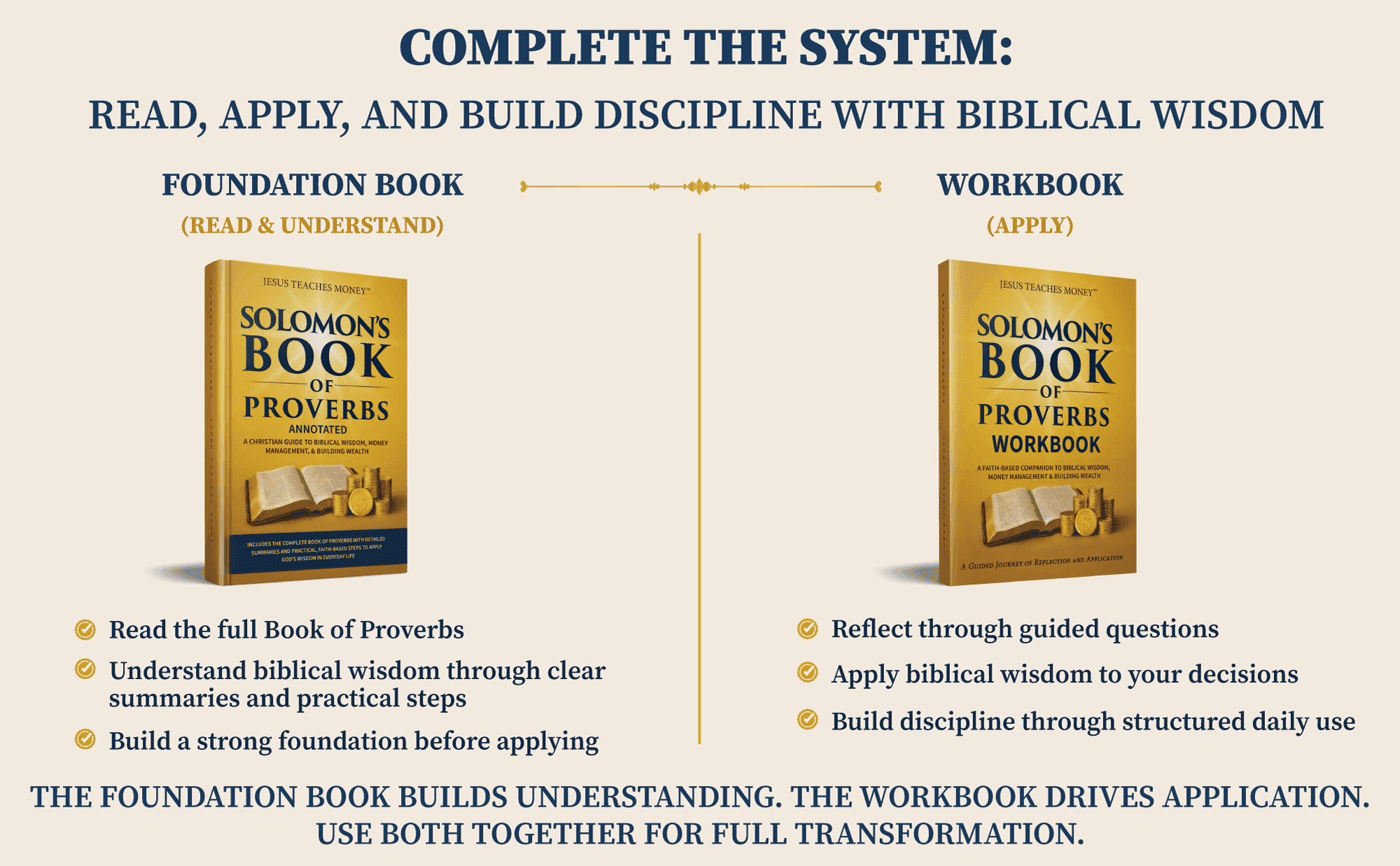
Abraham Duncan is the author of Solomon's Book of Proverbs (Annotated) and the creator of the Jesus Teaches Money™ framework, a structured system designed to help Christians apply biblical wisdom to daily life, stewardship, and financial decision-making.
FAQs
What is the best way to apply Proverbs daily?
Read one chapter slowly, identify one principle clearly, connect it to a specific area of your life, and take one concrete action. Repeat daily. Structure and consistency matter more than volume or intensity.
How does applying Proverbs improve financial decisions?
Proverbs addresses the behavioral and character patterns that drive financial outcomes: discipline, self-control, planning, stewardship, and long-term thinking. Applying it consistently shapes those patterns over time.
Where should I start?
Start with day one of the month and read the corresponding chapter. Identify one principle. Apply it today. The system works because it is simple enough to sustain.