
Table of Contents
- Direct Answer
- What Proverbs Is Actually Trying to Teach
- Why Wisdom Is the Central Theme
- The Fear of the Lord: The Foundation Everything Else Rests On
- How Proverbs Applies to Daily Life
- What Proverbs Says About Money and Stewardship
- Why Most People Fail to Apply Proverbs
- How to Apply the Main Message of Proverbs
- Common Misunderstandings About Proverbs
- Related Biblical Principles
- A Practical Next Step
- Apply Biblical Wisdom Daily
- Final Thoughts
- About the Author
- FAQs
Direct Answer
The main message of Proverbs is that wisdom leads to life, stability, and long-term blessing, while foolishness leads to destruction, instability, and regret. Proverbs does not define wisdom as intellectual knowledge alone. It defines wisdom as practical obedience, applied consistently in everyday decisions. The book's purpose is to develop discipline, stewardship, discernment, and sound judgment across every area of life.
What Proverbs Is Actually Trying to Teach
Most people who read Proverbs casually treat it as a collection of standalone inspirational sayings. That misses what the book is actually doing.
Proverbs is a structured body of practical wisdom designed to shape thinking, behavior, habits, speech, discipline, stewardship, decision-making, relationships, and long-term direction. The central theme running through it is consistent and direct: wise living produces stability, and foolish living produces destruction. That contrast appears throughout the book in various forms: wise versus foolish, diligent versus lazy, disciplined versus impulsive, patient versus reckless, humble versus proud.
What makes this more than a moral framework is the underlying claim: decisions produce consequences over time. Proverbs is not teaching that good behavior is admirable. It is teaching that behavior has a trajectory, and that trajectory matters. That principle applies spiritually, relationally, financially, and in virtually every other domain of ordinary life.
Why Wisdom Is the Central Theme
In Proverbs, wisdom does not mean intelligence or education. It means practical skill for living correctly according to God's principles. A person can possess significant information and still lack wisdom entirely. The two are not the same thing.
Biblical wisdom involves discernment, discipline, restraint, humility, correction, stewardship, and long-term thinking. It is a way of operating, not a body of knowledge to be accumulated.
This is what makes Proverbs so directly relevant today. Modern culture moves in almost the opposite direction: speed over patience, emotional reaction over considered judgment, instant gratification over discipline, appearance over substance. Proverbs does not accommodate those tendencies. It consistently calls them out as the path toward instability, and it makes that case in concrete, practical terms that have not become less true with time.
Human behavior has not changed. The wisdom that addressed it thousands of years ago still applies.
The Fear of the Lord: The Foundation Everything Else Rests On
Early in the book, Proverbs establishes the foundation its entire framework rests on:
"The fear of the Lord is the beginning of knowledge." (Proverbs 1:7)
This is not a reference to terror or dread. It refers to reverence, submission, and the recognition of God's authority. It means a willingness to follow His wisdom rather than defaulting to human impulse, pride, or short-term thinking.
This matters because Proverbs treats wisdom as inseparable from alignment with God's instruction. Many people pursue financial discipline, better decisions, and greater stability while simultaneously rejecting the biblical framework that produces them. Proverbs consistently shows where that leads: short-term gain pursued at the expense of long-term stability, foolish decisions rationalized through pride, correction ignored until consequences become unavoidable.
The foundation is not optional. Without it, the rest of what Proverbs teaches tends to get selectively applied in ways that miss the point.
How Proverbs Applies to Daily Life
One of the defining characteristics of Proverbs is that it addresses ordinary life without abstraction. It teaches wisdom regarding speech, money, work, relationships, emotions, discipline, planning, integrity, and stewardship in direct, practical terms.
It warns against laziness and emphasizes diligent work. It addresses reckless speech and the damage it produces. It teaches financial restraint and condemns dishonest gain. It promotes long-term thinking over impulsive decision-making. These are not theological discussions. They are operational instructions for real situations that real people face daily.
That is precisely what makes Proverbs applicable in a way that feels different from much of Scripture. It is not primarily narrative or theology at a distance. It is guidance designed to shape specific behavior in specific circumstances. Applying it consistently can improve discipline, stewardship, financial behavior, emotional control, and decision-making in measurable ways, but only if it is actually applied.
What Proverbs Says About Money and Stewardship
Many readers are surprised by how directly and frequently Proverbs addresses financial behavior. The book covers diligence, wealth, debt, planning, generosity, laziness, stewardship, greed, and impulsiveness in substantial detail. That is not incidental. It reflects a core conviction that runs throughout: financial outcomes are behavioral before they are mathematical.
Impulsive spending creates instability. Lack of planning creates pressure. Laziness limits growth. Greed distorts judgment. Poor stewardship creates consequences that compound over time. These connections are not presented as possibilities in Proverbs. They are presented as the natural outcome of how wisdom or foolishness operates in practical life.
One of the clearest expressions of this is Proverbs 13:11: gradual, disciplined accumulation produces increase, while shortcuts tend to produce loss. That principle appears in different forms throughout the book. The message does not change: wisdom applied consistently to financial decisions produces stability, and its absence tends to produce the opposite.
Why Most People Fail to Apply Proverbs
The gap most people experience with Proverbs is not a lack of exposure. It is a lack of structured application.
People read passively, feel briefly encouraged, forget most of what they read within days, and return to the same patterns. The content was never connected to a specific decision or behavior that needed to change. As a result, Proverbs functions as occasional inspiration rather than the behavioral formation system it was designed to be.
Proverbs was never intended to remain theoretical. It was written to shape conduct. Wisdom develops through repeated exposure, daily reflection, practical application, and behavioral correction over time. None of that happens through passive reading. It requires intentionality, and intentionality requires a structure to work within.
How to Apply the Main Message of Proverbs
The most effective approach is a simple daily system built around one chapter, one principle, and one action.
Step 1: Read One Chapter Daily
Proverbs has 31 chapters, which maps naturally to a one-chapter-per-day structure aligned to the day of the month. This creates consistent exposure without requiring significant time. Read slowly enough to notice what the chapter is actually saying, not just what it sounds like.
Step 2: Identify One Principle
Do not attempt to extract and apply multiple lessons at once. Choose one that stands out clearly and is directly relevant to where you are right now: discipline, stewardship, patience, planning, self-control, diligence. Focused application produces more lasting change than broad, scattered effort.
Step 3: Connect It to Real Life
Ask specific questions: What behavior needs correction? What habit lacks discipline? What financial decision in front of me requires more wisdom? Where am I operating impulsively? This is where the principle moves from the page into your actual life.
Step 4: Take One Specific Action
Make the application concrete. Track your spending today. Avoid an impulsive purchase. Plan tomorrow intentionally. Pause before a decision that usually gets made reactively. Guard an influence that has been shaping your thinking in the wrong direction. Small, repeated actions produce long-term change. That is not encouragement. It is how behavioral formation actually works.
Common Misunderstandings About Proverbs
1. Treating It Like a Collection of Random Quotes
Proverbs contains deeply interconnected themes around wisdom, discipline, stewardship, and behavior. Reading it systematically reveals a coherent framework that random quotation misses entirely.
2. Reading Without Applying
Knowledge does not change behavior on its own. Application does. Reading Proverbs and living by Proverbs are two different things, and only one of them produces results.
3. Expecting Instant Transformation
Proverbs teaches gradual growth through repeated discipline. Expecting significant change from occasional reading without consistent application is a fundamental misunderstanding of how the book works.
4. Treating It as Purely Spiritual and Ignoring the Practical
Proverbs addresses money, work ethic, planning, discipline, and stewardship in direct, specific terms. Spiritualizing it while ignoring those areas misses a significant portion of what the book is actually teaching.
Related Biblical Principles
Several passages throughout Proverbs reinforce the central message from different angles:
- Proverbs 13:11 establishes that disciplined, gradual growth outlasts anything built through shortcuts or haste.
- Proverbs 21:5 connects diligent planning with long-term abundance and warns that impulsiveness leads to loss.
- Proverbs 4:23 addresses the internal condition that shapes all outward behavior, including financial behavior.
- Proverbs 3:5–6 calls for consistent dependence on God's wisdom rather than self-reliance across every area of daily life.
Together, these passages reinforce the main message of Proverbs from multiple directions: wisdom applied consistently produces stability, and the absence of it produces the opposite.
A Practical Next Step
For the next seven days, commit to this:
- Read one chapter of Proverbs daily, slowly and deliberately.
- Identify one principle that applies directly to your current situation.
- Take one specific, measurable action based on what you identified.
Consistency matters more than perfection. Wisdom compounds over time through repeated disciplined action. That is the mechanism Proverbs describes throughout, and it works the same way now as it always has.
Apply Biblical Wisdom Daily
Proverbs becomes transformational when wisdom moves beyond reading and into consistent daily application. Understanding the main message of Proverbs is a starting point. What you do with it is what determines the outcome.
👉 Explore the 31-Day Proverbs Wealth System
Final Thoughts
The main message of Proverbs is not a call to accumulate more knowledge. It is a call to live wisely, through disciplined daily decisions applied consistently over time. That kind of wisdom does not produce dramatic overnight results. It produces something more durable: habits, stewardship, and direction that hold up under real circumstances and compound in the right direction year after year.
About the Author
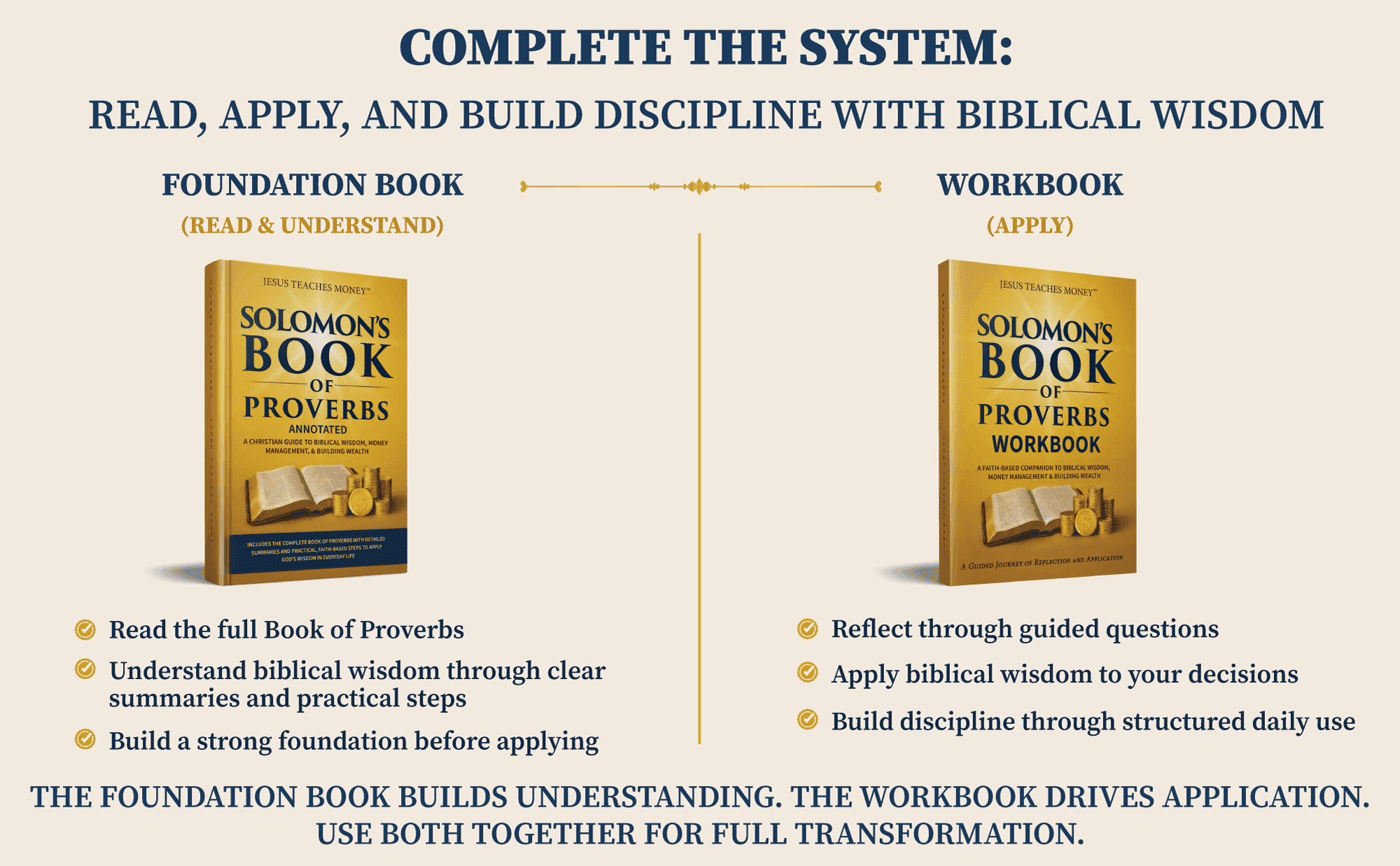
Abraham Duncan is the author of Solomon's Book of Proverbs (Annotated) and the creator of the Jesus Teaches Money™ framework, a structured system designed to help Christians apply biblical wisdom to daily life, stewardship, and financial decision-making.
FAQs
What is the main message of Proverbs?
That wisdom, consistently applied to daily decisions, habits, and behavior, produces stability and life, while foolishness consistently applied produces the opposite. The book's purpose is behavioral formation, not inspirational reading.
How does the wisdom from Proverbs apply to financial decisions?
Proverbs addresses the behavioral patterns that drive financial outcomes: discipline, planning, stewardship, self-control, and long-term thinking. As those patterns change, financial results tend to follow.
What is the best way to start applying Proverbs daily?
Read the chapter corresponding to today's date, identify one principle that is directly relevant to your current life, and take one concrete action based on it. Start there and build from consistency.