
Table of Contents
- Direct Answer
- Why Proverbs Works So Well as a Daily Study System
- Why Reading Proverbs Daily Is Not Enough
- How to Use Proverbs for the Day Effectively
- How Proverbs Applies to Financial Decisions
- Why Most People Fail to Stay Consistent
- Common Mistakes People Make With Daily Proverbs Study
- Related Biblical Principles
- A Practical Next Step
- Apply Biblical Wisdom Daily
- Final Thoughts
- About the Author
- FAQs
Direct Answer
Using Proverbs for the day is one of the simplest and most effective ways to build a consistent biblical wisdom practice. Because Proverbs contains 31 chapters, the structure maps naturally to a daily reading system: one chapter per day, aligned to the day of the month. The key, though, is not merely reading it. The difference between inspiration and actual transformation is whether that daily reading gets applied to real decisions, habits, stewardship, and discipline.
Why Proverbs Works So Well as a Daily Study System
Most Bible reading plans require significant time investment, complex schedules, or long stretches of narrative that can be difficult to connect directly to daily life. Proverbs is different.
The book is built around practical wisdom: discipline, stewardship, decision-making, relationships, speech, diligence, habits, and long-term thinking. It is less concerned with theological abstraction and more concerned with how a person actually lives from day to day. That focus makes it immediately applicable in a way that few other books of Scripture are.
The structure reinforces this. Thirty-one chapters. One per day. Repeated monthly. That simplicity is not a limitation; it is the feature. Most people fail to stay consistent with Bible study not because they lack motivation but because their approach is unsustainable. A daily Proverbs reading system is simple enough to maintain long term, and long-term consistency is where the real value compounds.
This is also why "Proverbs for the day" is one of the most commonly searched biblical study terms. People are not looking for complexity. They are looking for daily wisdom, practical guidance, and a structure that fits into real life.
Why Reading Proverbs Daily Is Not Enough
Here is where most people stall: they read the chapter, feel a moment of clarity or conviction, and move on. Nothing changes. The next day, the same.
Wisdom is not transferred through passive exposure. Proverbs itself makes this clear repeatedly. The book emphasizes discipline, correction, application, and repeated practice, not familiarity with content. You can read Proverbs every day for a year and still make impulsive financial decisions, maintain undisciplined habits, and react emotionally to circumstances if you never move from reading to intentional application.
The gap is not information. Most people already know more than they are applying. The gap is structure. Without a clear process for connecting what you read to what you actually do, daily Proverbs reading becomes another form of passive consumption, which is precisely what Proverbs warns against.
The shift from inspiration to formation happens when wisdom moves from the page into repeated, specific action.
How to Use Proverbs for the Day Effectively
A simple, repeatable process works better than an elaborate one. Here is a practical daily framework built around one chapter, one principle, and one action.
Step 1: Read One Chapter Slowly
Resist the impulse to move through the chapter quickly just to complete it. Read deliberately. Pay attention to repeated themes, warnings, contrasts, and practical instructions. Proverbs frequently teaches through comparison: wise versus foolish, disciplined versus lazy, patient versus impulsive, diligent versus careless. Those contrasts are the instruction. Slow reading is what allows them to land.
Step 2: Identify One Principle
Do not attempt to extract and apply everything at once. That approach collapses under its own weight within days. Choose one principle that stands out clearly and is directly relevant to where you are right now, whether that is discipline, patience, stewardship, self-control, guarding your influences, or planning ahead. Focused application produces more lasting change than broad, scattered effort.
Step 3: Connect It to Your Actual Life
This is the step most people skip, and it is the most consequential one. Ask specific questions: How does this principle apply to my habits? What financial behavior needs honest correction? Where am I being impulsive? What decision in front of me requires more wisdom than I have been bringing to it? What influence is shaping my thinking in a direction I have not examined?
Wisdom grows when biblical principles get connected to real, specific circumstances, not when they remain in the general.
Step 4: Take One Practical Action
Make the application concrete and measurable. Track your spending today. Avoid an emotionally driven purchase. Create a simple budget. Pause before reacting to a financial pressure. Reduce a specific distraction. Review your financial priorities against a clear standard. The action does not need to be large. It needs to be real, specific, and repeated.
Step 5: Repeat Daily
Consistency is the entire mechanism. Proverbs reinforces this pattern throughout: wisdom develops gradually through repetition, discipline, correction, and long-term practice. Most meaningful transformation happens slowly. A daily Proverbs system works because it is designed for sustainability, not intensity. One chapter. One principle. One action. Every day.
How Proverbs Applies to Financial Decisions
One of the reasons Proverbs has remained practically relevant across centuries is that it consistently addresses the behavioral patterns that drive financial outcomes.
Impulsive spending, poor planning, emotional decision-making, debt accumulation, greed, comparison, and lack of self-control are not primarily financial problems. They are wisdom problems. They originate in habits, character, and internal condition before they ever show up in a bank account or a credit card balance.
Proverbs addresses them at that level. Disciplined habits create stability. Wise planning prevents loss. Diligence produces increase. Impulsiveness creates problems that compound. Stewardship is treated throughout as a non-negotiable responsibility, not an advanced spiritual concept.
This is why consistent daily Proverbs study can produce genuine improvement in financial discipline, long-term thinking, and decision-making in ways that financial strategies or budgeting tools alone cannot. The behavior has to change first. The financial outcomes tend to follow.
Why Most People Fail to Stay Consistent
The most common reason people abandon a daily study practice is not lack of desire. It is overcomplication.
They set unrealistic goals, attempt dramatic overnight change, try to process too much at once, and quit when the system proves unsustainable. The solution is not more motivation. It is a simpler system.
Reading one chapter, identifying one principle, and taking one action is a commitment that fits into an ordinary day. That is the point. Proverbs itself reinforces gradual growth through consistent discipline repeatedly throughout the text. A system you can maintain for a year produces more transformation than an intensive plan you abandon in two weeks.
Common Mistakes People Make With Daily Proverbs Study
1. Reading Without Applying
Exposure to wisdom without application is just information. Transformation requires that what you read gets translated into specific behavior. That step has to be intentional.
2. Treating Proverbs Like a Collection of Motivational Quotes
Proverbs is practical instruction designed to shape habits, decisions, and character over time. It rewards systematic study far more than random quotation.
3. Attempting Too Much at Once
Consistent small actions compound into significant change. Emotional overcorrection followed by burnout produces nothing. Focus on one principle at a time and build from there.
4. Limiting Application to the Spiritual and Ignoring the Practical
Proverbs consistently connects wisdom to money, discipline, stewardship, habits, diligence, and planning. Treating it as purely devotional material misses the majority of what the book is actually teaching.
Related Biblical Principles
Several passages throughout Proverbs reinforce the value of daily wisdom and disciplined, consistent application:
- Proverbs 13:11 establishes that gradual, disciplined growth produces more lasting results than anything built on haste.
- Proverbs 21:5 connects diligent planning with long-term abundance and warns that impulsiveness leads to loss.
- Proverbs 4:23 addresses the internal condition that shapes all behavior, including financial behavior.
- Proverbs 3:5–6 calls for consistent dependence on God's wisdom over self-reliance across every area of daily life.
Together, these passages make the same argument: wisdom must become a practiced daily habit to produce the long-term transformation it promises.
A Practical Next Step
Starting tomorrow, commit to this system for seven days:
- Read one chapter of Proverbs, slowly and deliberately.
- Identify one principle that applies directly to your current circumstances.
- Take one specific, measurable action based on what you identified.
Do not pursue perfection. Pursue consistency. Repeated wisdom applied daily is what produces long-term change. That is not an encouraging platitude. It is the mechanism Proverbs describes throughout.
Apply Biblical Wisdom Daily
Consistent wisdom applied daily produces stronger habits, better stewardship, clearer decisions, and real long-term change. Reading this article is a starting point. What you do with it is what matters.
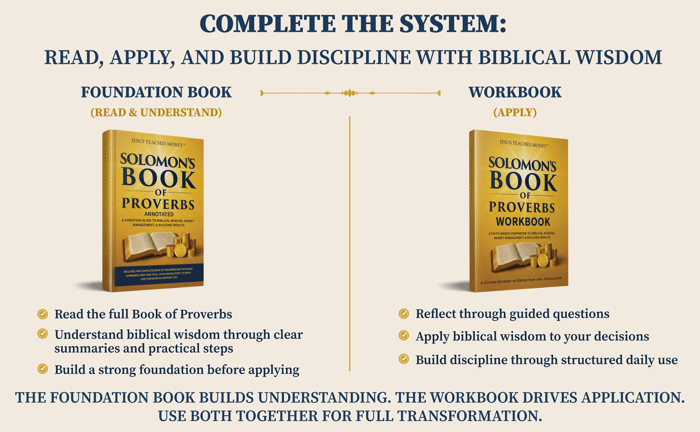
👉 Explore the 31-Day Proverbs Wealth System
Final Thoughts
Using Proverbs for the day is not about collecting encouraging thoughts to carry into the morning. It is about building a daily practice of applying biblical wisdom to real decisions, real habits, and real financial behavior. Over time, that repeated application reshapes how you think, what you prioritize, and how you live. The knowledge is accessible. The system is simple. Consistent application is what makes it work.
About the Author
Abraham Duncan is the author of Solomon's Book of Proverbs (Annotated) and the creator of the Jesus Teaches Money™ framework, a structured system designed to help Christians apply biblical wisdom to daily life, stewardship, and financial decision-making.
FAQs
How is a daily Proverbs reading system structured?
Read the chapter that corresponds to the day of the month. Identify one clear principle. Connect it to a specific area of your life. Take one practical action. Repeat daily.
How does daily Proverbs study improve financial decisions?
It addresses the behavioral patterns that drive financial outcomes: discipline, self-control, stewardship, planning, and long-term thinking. As those patterns change, financial decisions tend to follow.
What is the right place to start?
Open to the chapter that matches today's date and read it slowly. Identify one principle that is directly relevant to where you are right now. Apply it today. Begin there.