
Table of Contents
- What Does the Bible Actually Teach About Wealth?
- Two Common Misunderstandings About Biblical Wealth
- How Biblical Money Principles Apply to Real Financial Decisions
- Practical Action Step
- Common Mistakes Christians Make About Biblical Wealth
- Key Proverbs on Biblical Wealth Principles
- Apply These Biblical Money Principles Consistently
- Closing Thoughts
- About the Author
- FAQs
What Does the Bible Actually Teach About Wealth?
The Bible teaches that money is a tool, not a master. Biblical money principles center on stewardship, discipline, generosity, wisdom, and long-term responsibility. Scripture does not condemn wealth itself, but it consistently warns against the love of money, pride, laziness, and dishonest gain. The distinction matters, and most people miss it.
Two Common Misunderstandings About Biblical Wealth
Few topics in Scripture get more consistently misread than money.
Some Christians conclude that wealth is inherently suspect, that desiring financial stability reflects poor spiritual priorities. Others land in the opposite error, treating financial success as a reliable sign of God's favor. Neither view holds up under a careful reading of Scripture.
What the Bible actually presents is more demanding than either position: wealth is a responsibility, and how you manage it reflects the condition of your character.
Throughout Proverbs, biblical wisdom links financial outcomes directly to daily habits. Diligence, discipline, patience, integrity, and self-control appear again and again as the foundations of sustainable prosperity. At the same time, the text warns plainly against impulsive decisions, laziness, dishonest gain, and the pursuit of quick riches.
The issue Scripture raises is rarely money itself. The issue is whether money controls your decisions, your priorities, and ultimately your character.
One of the clearest biblical money principles appears in Proverbs 13:11:
"Wealth gained hastily will dwindle, but whoever gathers little by little will increase it."
That principle runs directly against the dominant financial culture most people live in, one built on shortcuts, instant gratification, and the persistent myth that wealth can be hurried. The biblical approach is slower, more disciplined, and far more durable.
How Biblical Money Principles Apply to Real Financial Decisions
Christian financial stewardship is not limited to giving. It shapes every dimension of how you handle money.
How you earn it. How you spend it. How you save it. How you plan for the future. How you respond under financial pressure. The biblical view of wealth touches all of it.
Practically, this means:
- Living below your means rather than at or beyond them
- Avoiding debt that is unnecessary or driven by impatience
- Planning deliberately instead of reacting emotionally
- Using money as a tool for long-term stability and generosity, not status
Many financial problems are not primarily income problems. They are discipline problems, planning problems, and behavioral problems that more income alone will not fix. Money magnifies existing habits. It rarely corrects them.
Proverbs connects wisdom with consistency, not with isolated moments of motivation. Small daily decisions compound over time. Disciplined spending, regular saving, controlled habits, honest work. These are not dramatic actions. They are the kind of quiet, repeated choices that build financial stability across years, not weeks.
The Bible also makes clear that wealth should never become your identity or your source of security. Financial status is unstable. Wisdom, stewardship, and character outlast it.
Practical Action Step
Pull up your last 30 days of spending and look at it honestly.
Identify one impulsive habit, one unnecessary recurring expense, and one area where you consistently avoid planning ahead.
Then choose one disciplined action to replace that behavior this week. Not five changes. One.
Options worth starting with:
- Set a firm spending limit in one category where you consistently overspend
- Automate a fixed savings amount before discretionary spending begins
- Delay any non-essential purchase for 24 hours before buying
- Track every expense for seven consecutive days without exception
Consistent small actions build more durable financial progress than temporary surges of motivation. Start small, but do not stop.
Common Mistakes Christians Make About Biblical Wealth
1. Believing Money Is Inherently Evil
This is a misquote most people do not realize they are making. Scripture does not say money is evil. It says:
"The love of money is a root of all kinds of evils." (1 Timothy 6:10)
Money is a tool. The danger lies in greed, obsession, and misplaced priorities, not in the resource itself.
2. Chasing Quick Wealth
Proverbs returns to this warning more than once. Shortcuts are not neutral. They actively undermine financial stability. Many people spend years recovering from decisions that felt fast and promising at the time.
3. Ignoring Stewardship While Praying for Increase
Biblical stewardship requires action, not just belief. Praying for financial growth while continuing undisciplined habits is not faith. It is avoidance dressed up as spirituality.
4. Separating Financial Decisions From Faith
Scripture does not create a wall between spiritual life and practical life. Your financial habits reveal your discipline, your priorities, and your actual values. Money management is almost always a behavioral issue before it becomes a math issue.
Key Proverbs on Biblical Wealth Principles
Proverbs 21:5 "The plans of the diligent lead surely to abundance, but everyone who is hasty comes only to poverty."
Planning and patience are not passive virtues. They are active disciplines that produce measurable outcomes.
Proverbs 22:7 "The rich rules over the poor, and the borrower is the slave of the lender."
Debt is not neutral. It is a transfer of authority over your financial decisions to someone else. The biblical view of wealth treats this as a condition worth avoiding deliberately.
Proverbs 10:4 "A slack hand causes poverty, but the hand of the diligent makes rich."
Productive, consistent work is a biblical financial principle, not just a cultural expectation.
Luke 16:10 "One who is faithful in a very little is also faithful in much."
Stewardship does not begin when your income reaches a certain level. It begins with what you have now.
Apply These Biblical Money Principles Consistently
Reading biblical wisdom is a legitimate starting point. But transformation does not come from reading alone. It comes from consistent, structured application over time.
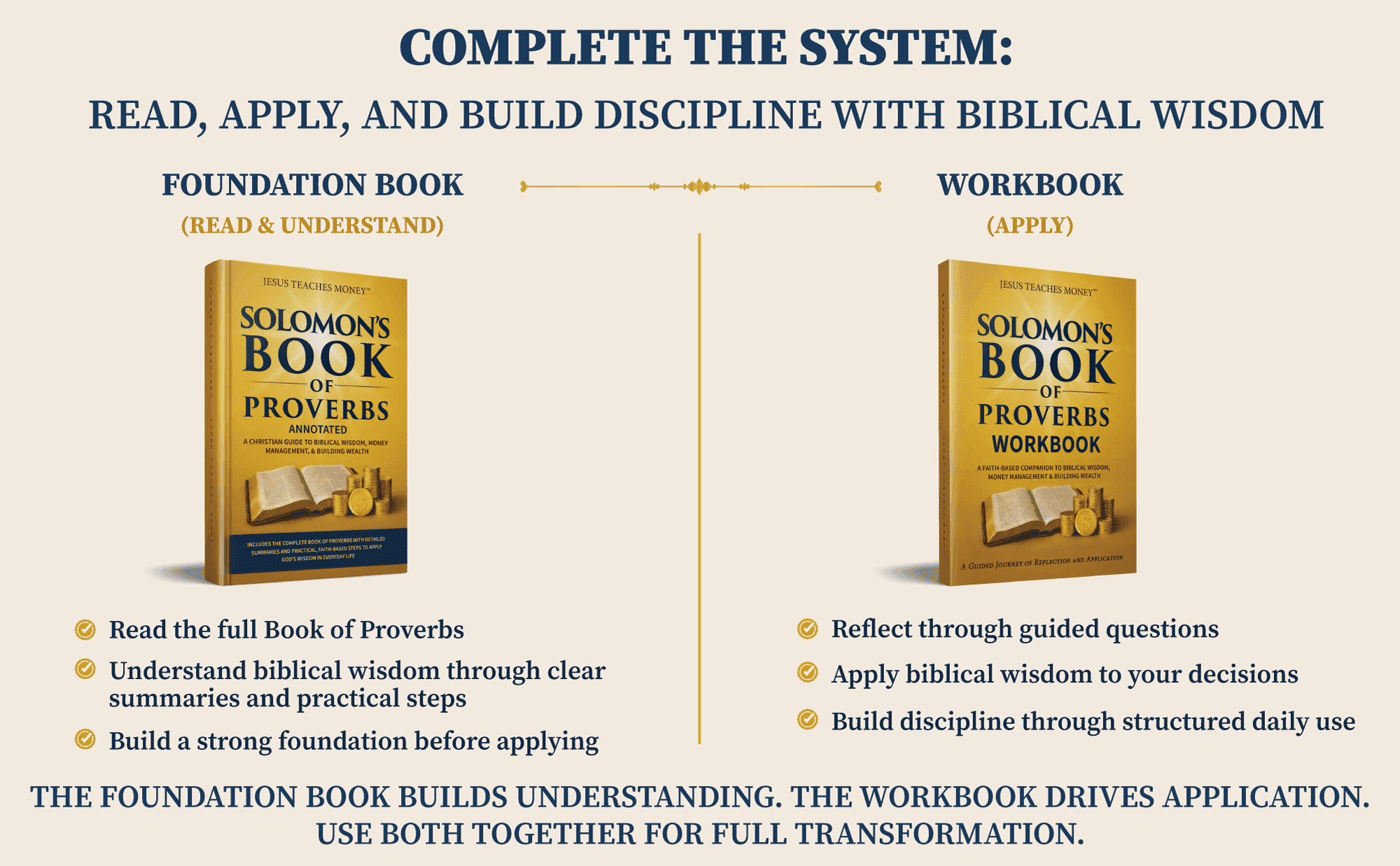
The Jesus Teaches Money™ 31-Day Proverbs System was built for exactly this. It moves Christians past passive familiarity with Proverbs and into a daily practice of applying biblical wisdom to real financial decisions, habits, and stewardship.
If you are ready to close the gap between what you know and how you actually live financially, this is where that work begins.
👉 Explore the 31-Day Proverbs Wealth System
Closing Thoughts
Biblical wisdom is not meant to stay theoretical. It is designed to shape daily decisions, including financial ones. When biblical money principles are applied consistently over time, they produce something motivation alone never can: genuine discipline, stronger stewardship, and financial habits that hold up across seasons, not just moments of inspiration.
The knowledge was never the obstacle. Consistent application is where everything changes.
FAQs
What do biblical money principles mean?
They are the financial teachings found throughout Scripture that emphasize wisdom, stewardship, discipline, honesty, generosity, and responsible decision-making. They are practical by design, not merely inspirational.
What does the Bible say about wealth?
Wealth itself is not sinful. The love of money and the misuse of wealth are. Scripture treats money as a resource to be managed wisely and held loosely, never as an idol or a measure of worth.
How do these principles apply to everyday money management?
They directly shape earning, spending, saving, debt decisions, generosity, and long-term financial planning. Biblical wisdom consistently pushes toward disciplined, responsible stewardship and away from impulsive or emotionally driven financial behavior.
What is one action I should take first?
Identify one financial habit that lacks discipline and replace it with one consistent, measurable action this week. Keep the focus on long-term stewardship rather than short-term results.