What does the Bible say about money? Scripture provides clear principles about stewardship, discipline, wealth building, generosity, and financial wisdom. Yet many Christians struggle to apply those principles consistently in daily life.
Despite how often people ask what the Bible says about money, the answers they find tend to fall into two extremes: either wealth is spiritually dangerous, or faith and finances have nothing to do with each other.
Neither is accurate.
The Bible does not condemn money. It gives clear guidance on how to think about it, how to manage it, and how to use it in a way that reflects wisdom and purpose. At its core, Scripture treats money as a tool. And how you handle that tool reveals a great deal about your discipline, your priorities, and your stewardship.
Biblical Money Principles: What Scripture Actually Teaches
When you study the Bible carefully, especially Proverbs, consistent principles emerge. These are not abstract ideals. They are practical frameworks for how financial decisions should be made and why.
1. Stewardship, Not Ownership
The Bible's foundational position on wealth is simple: everything belongs to God. You are not an owner; you are a manager. That distinction matters more than most people realize.
When you internalize biblical stewardship, your entire relationship with money shifts. You become more intentional. You think longer term. You stop making careless decisions because you understand that you are accountable for what you have been given, not just entitled to spend it.
2. Wisdom Over Emotion in Financial Decisions
Emotion-driven financial decisions are consistently costly, and the Bible addresses this directly. Proverbs repeatedly calls the reader toward understanding, careful thought, and disciplined action before spending, lending, or committing resources.
Wealth is not built through impulse or luck. It is built through repeated wise decisions made over time, even when those decisions are inconvenient or require patience.
3. Discipline and Consistency Build Wealth
This is one of the most underappreciated biblical money principles. Proverbs does not glorify windfalls or shortcuts. It emphasizes diligence, steady progress, and the compounding effect of faithful small actions.
Financial growth comes from consistent habits, not dramatic moments. Small disciplines practiced daily produce results that no single financial decision ever could.
4. Avoiding Debt and Destructive Patterns
The Bible is direct about the patterns that keep people financially stuck: debt dependency, laziness, and short-term thinking. These are not just moral warnings; they are practical observations about how financial instability actually develops.
None of these patterns are income problems. They are behavioral patterns that persist across every income level until they are deliberately interrupted.
5. Generosity and Purpose
Biblical wealth is not just about accumulation. Money, according to Scripture, is meant to serve, to support meaningful work, and to reflect what you actually value. When your finances have a clear purpose beyond your own comfort, money becomes more than income. It becomes a vehicle for impact.
Why Most People Struggle to Apply These Principles
Understanding what the Bible says about money is the straightforward part. Most people who have spent any time in Scripture already know the principles: stewardship, discipline, wisdom, and generosity.
The harder question is: why aren't those principles showing up in your actual financial life?
Here is what most people experience. They read the right things, understand them intellectually, feel conviction about them on Sunday, and then spend Monday through Saturday making the same financial decisions they always have. Not because they are careless people. Not because they lack faith. But because understanding a principle and consistently living by it are two entirely different skills.
Knowledge without structure tends to stay knowledge. The information sits in your mind, but it never makes it into your habits, your budget, or your daily decisions. Over time, the gap between what you know and what you actually do becomes a source of frustration rather than growth.
This is not a motivation problem. Motivation comes and goes. It is a systems problem.
How to Manage Money Biblically: A Practical Approach
If you are serious about applying what the Bible teaches about money, you need more than occasional inspiration. You need a clear process, daily engagement with biblical wisdom, and a structure that helps you move from understanding to application without relying on willpower alone.
Reading Scripture occasionally will not produce consistent financial results. Neither will general awareness of what the Bible says. What produces results is a repeatable system that keeps you engaged with these principles daily, helps you reflect on where you are falling short, and gives you practical steps to apply what you are learning in real time.
That is how biblical principles become habits. And habits are what produce real, measurable change.
Start Building the System That Closes the Gap
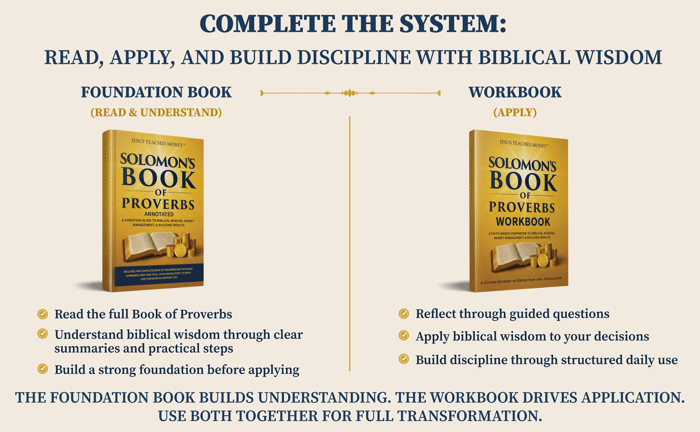
If you are ready to move from knowing to doing, the Jesus Teaches Money™ 31-Day Proverbs System was built for exactly that purpose.
It gives you a structured daily process grounded in Proverbs, practical application steps that connect Scripture to your real financial decisions, and a framework designed to build consistency rather than rely on motivation.
This is not a devotional. It is a system. And the difference matters.
👉 Explore the 31-Day Proverbs Wealth System
The system combines the complete Book of Proverbs with guided application exercises designed to help you build discipline, stewardship, and consistent financial decision-making rooted in Scripture.
Start the 31-Day Proverbs System
Final Thoughts
The Bible provides clear, actionable guidance on stewardship, discipline, wisdom, and financial growth. That guidance is available to anyone willing to engage with it seriously.
But the gap between knowing what the Bible says about money and actually seeing results in your financial life comes down to one thing: consistent application. Not perfect application. Consistent application.
That is the work. And it is worth doing.
About the Author
Abraham Duncan is the author of Solomon’s Book of Proverbs (Annotated) and the creator of the Jesus Teaches Money™ framework, a structured system designed to help Christians apply biblical wisdom to daily life, stewardship, and financial decision-making.