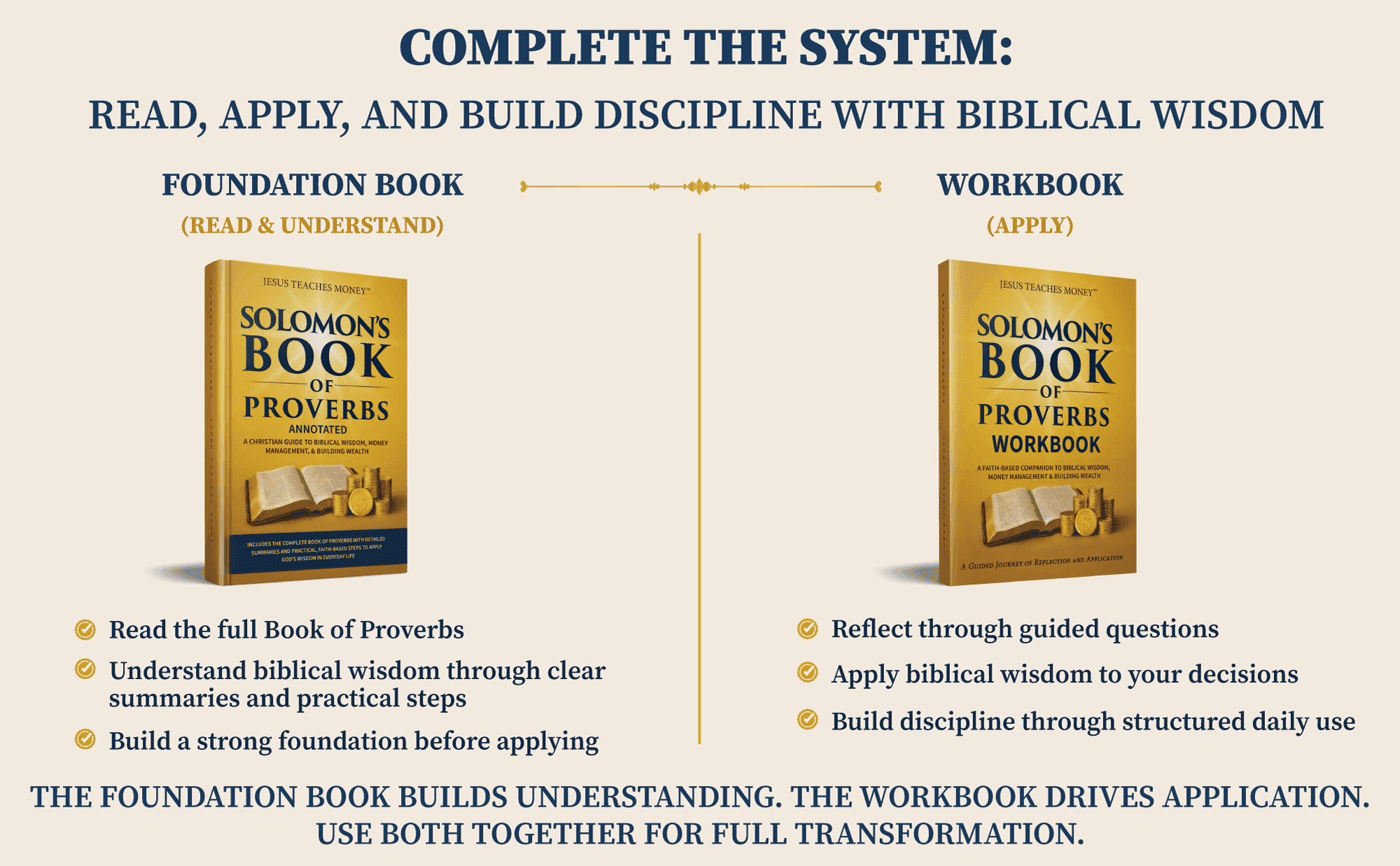
Why do most Christians struggle with money? Many Christians struggle financially not because they lack information, but because understanding biblical wisdom and consistently applying it are two entirely different things. Scripture speaks clearly about stewardship, discipline, wisdom, diligence, and self-control. But without structure and repeated application, those principles rarely become the habits that actually shape financial behavior.
That gap, between what we know and what we consistently do, is where most financial struggles begin.
What the Bible Actually Teaches About Money and Stewardship
The Bible does not treat financial wisdom as optional or secondary. It connects financial stability directly to wisdom, discipline, and long-term thinking. Proverbs, in particular, returns to this theme repeatedly, warning against impulsive decisions, emotional spending, laziness, and the false security of short-term thinking.
Biblical stewardship is broader than giving or budgeting. It is about managing every resource under your care with wisdom and intentionality, making decisions that reflect sound judgment rather than temporary emotion.
Most Christians understand this conceptually. They have heard the sermons and read the passages. But intellectual understanding is not the same as a disciplined financial habit, and confusing the two is one of the most common reasons why good people continue making poor financial decisions.
Why Christians Continue Making Poor Financial Decisions
Here is a truth worth sitting with: motivation does not create lasting change. Structure does.
Many believers leave a sermon on stewardship feeling genuinely inspired. They intend to budget differently, spend more carefully, or finally address a debt they have been avoiding. But inspiration without a supporting system fades within days. When the feeling fades, old patterns return, and the cycle repeats.
This is why so many Christians, despite genuinely believing biblical truth, continue to:
- Overspend emotionally
- Avoid budgeting or reviewing their finances
- Remain stuck in debt cycles they cannot seem to break
- Fail to save consistently
- Make reactive financial decisions instead of intentional ones
The issue is rarely income alone. The deeper issue is inconsistent decision-making repeated over time. Proverbs makes this plain: small, repeated actions shape long-term outcomes. Financial stability is not usually built through one dramatic decision. It is built, quietly and steadily, through daily habits practiced with discipline.
The Real Financial Problem Most People Ignore
Most financial problems are behavioral before they are mathematical.
When people feel financial pressure, the instinct is to look for an income solution, a better-paying job, a side income, a faster path to wealth. These are not bad goals. But Scripture does not primarily address financial struggle with a strategy for earning more. It addresses it with a call to wisdom, patience, diligence, and stewardship.
Without those foundations, more income rarely produces stability. It produces larger versions of the same problems. Spending expands. Debt grows. The same habits that created the original problem now operate at a higher level.
Money magnifies existing habits. It does not correct them.
This is the financial reality most people never confront directly, and it explains why so many well-meaning Christians remain stuck despite sincere effort.
How Biblical Wisdom Applies to Your Financial Life
Biblical money principles are not abstract. They are directly applicable to the decisions most people make every week.
Specifically, they shape:
- Spending decisions: Does this purchase reflect wisdom or impulse?
- Saving habits: Am I building for the future or only responding to the present?
- Debt management: Am I treating Proverbs 22:7 as a warning worth heeding?
- Long-term planning: Do my financial decisions reflect a one-year mindset or a ten-year mindset?
- Generosity: Is giving a discipline I practice, or something I get to when there is leftover?
- Emotional discipline: Am I making financial decisions from clarity or from stress?
Impulsive purchases weaken stewardship. Inconsistent saving creates fragility. Emotional financial decisions almost always produce regret. Avoiding financial responsibility only delays the consequences.
Learning how to manage money biblically requires more than information. It requires consistent financial discipline practiced through daily decisions and long-term stewardship.
Applying biblical wisdom practically means slowing down decisions, thinking beyond the immediate, and building structures that reinforce discipline even when motivation is low. That is how financial transformation actually happens. Not through inspiration alone, but through consistent, disciplined application of sound principles.
Practical Action Step
Choose one recurring financial habit that repeatedly creates instability in your life. Not five habits. One.
Then replace it with one disciplined action you can repeat daily or weekly.
Practical starting points:
- Track every dollar you spend for seven consecutive days
- Set a fixed savings amount and automate it before you can spend it
- Institute a 24-hour delay before any unplanned purchase
- Schedule a weekly financial review, even 15 minutes
- Read one chapter of Proverbs daily before making any significant financial decision
Start small. Stay consistent. Small, repeated actions compound over time in ways that a single dramatic decision never can.
Common Mistakes Christians Make With Money
1. Relying on Motivation Instead of Structure
Motivation is useful for starting. It is not sufficient for sustaining. Discipline requires systems, repetition, and accountability. Build the system first.
2. Treating Financial Problems as Only Income Problems
More income directed by the same undisciplined habits produces the same results at a larger scale. Address the behavioral patterns before chasing more earnings.
3. Dismissing Small Daily Decisions
The small choices, what you spend, what you skip, what you save, consistently create larger long-term outcomes than any single dramatic financial moment. Proverbs understands this. Most modern financial advice does not.
4. Separating Faith From Financial Decisions
Scripture treats stewardship as part of daily obedience, not a category reserved for tithing conversations. How you handle money is a reflection of how you handle responsibility. The two cannot be neatly separated.
Several key passages reinforce these principles directly:
- Proverbs 13:11 teaches that wealth accumulated gradually through diligence is far more sustainable than quick gain
- Proverbs 21:5 connects careful, deliberate planning with abundance and hasty decisions with loss
- Proverbs 22:7 gives a sober warning about the long-term bondage that debt creates
- Proverbs 6:6–8 holds up the ant as a model of preparation, diligence, and self-directed responsibility
Together, these passages form a consistent biblical framework for Christian money management rooted in wisdom, not wishful thinking.
Start Applying Biblical Wisdom Consistently
Understanding biblical financial principles is a starting point. Consistently applying them is where real change happens.
The Jesus Teaches Money™ 31-Day Proverbs System was built to bridge that gap. Instead of relying on motivation that fades, it provides structured daily guidance drawn directly from Proverbs, paired with practical application exercises and a framework designed to build the kind of long-term discipline and stewardship that actually reshapes financial behavior.
If you are ready to move beyond inspiration and start building disciplined financial habits rooted in biblical wisdom, this is the system designed to take you there.
👉 Explore the 31-Day Proverbs Wealth System
Final Thoughts
Biblical wisdom is not meant to be read once and filed away. It is meant to be applied consistently, day after day, decision after decision. When discipline, stewardship, patience, and sound judgment become your daily operating principles rather than concepts you admire, your habits begin to shift. And over time, your financial life shifts with them.
The knowledge was never the problem. Consistent application is where transformation begins.
About the Author
Abraham Duncan is the author of Solomon’s Book of Proverbs (Annotated) and the creator of the Jesus Teaches Money™ framework, a structured system designed to help Christians apply biblical wisdom to daily life, stewardship, and financial decision-making.