
Table of Contents
- Direct Answer
- What Does Proverbs 4:23 Mean?
- Why an Unguarded Heart Is a Practical Problem
- How Proverbs 4:23 Applies to Money and Financial Decisions
- The Danger of Leaving Your Heart Unguarded
- How to Guard Your Heart Biblically
- A Practical Next Step
- Common Mistakes Christians Make About This Verse
- Related Biblical Principles
- Apply Biblical Wisdom Consistently
- Final Thoughts
- About the Author
- FAQs
Direct Answer
Proverbs 4:23 teaches that your inner life shapes your outer life. Your thoughts, desires, emotions, priorities, and the influences you allow access to will eventually determine your decisions, habits, and financial direction. An unguarded heart does not stay neutral; it drifts, and your life follows.
Guarding your heart is not about isolation or fear. It is about intentionally protecting what shapes you, before it shapes your decisions for you.
What Does Proverbs 4:23 Mean?
Proverbs 4:23 says:
"Above all else, guard your heart, for everything you do flows from it."
That opening phrase carries real weight. "Above all else" is not rhetorical emphasis. Solomon is establishing priority. Before protecting your income, your reputation, your opportunities, or your status, Scripture says to protect the internal condition that drives everything else.
In biblical language, the heart represents the center of a person's thinking, desires, motives, and decision-making. It is not merely the seat of emotion. It is the source of direction.
That distinction matters. Proverbs 4:23 is not simply about managing how you feel. It is about understanding what governs where you are headed.
If fear dominates your heart, fearful decisions follow. If greed takes hold, destructive financial choices follow. If wisdom governs your heart, disciplined and deliberate action begins to follow, consistently, over time.
Most people focus on outcomes: more income, better opportunities, financial breakthroughs, external markers of success. Proverbs is concerned with the source producing those outcomes. The condition of the heart is that source. Everything else flows downstream from it.
Why an Unguarded Heart Is a Practical Problem
Most people significantly underestimate how much their environment shapes their decisions.
What you repeatedly watch, consume, admire, and tolerate does not stay outside you. Over time, repeated exposure becomes normalized thinking, and normalized thinking becomes default behavior. That process is quiet, gradual, and largely invisible until the results become hard to ignore.
A person who consistently absorbs fear-driven content, comparison, materialism, impulsive financial behavior, and undisciplined lifestyles will eventually make decisions that reflect those influences. Not because they chose that direction consciously, but because they never chose against it.
The opposite is equally true. When you consistently feed your mind with wisdom, discipline, sound instruction, and biblical stewardship, your decisions begin moving in a different direction. Not overnight, but steadily.
Proverbs teaches that life flows downstream from internal formation. People rarely collapse through one dramatic failure. More often, decline happens gradually through small, repeated compromises and influences left unexamined.
How Proverbs 4:23 Applies to Money and Financial Decisions
One of the most direct places to observe the condition of the heart is in how a person manages money.
Financial problems are often treated as math problems. Sometimes they are. But a significant portion of financial struggle is behavioral and emotional before it ever becomes mathematical. Emotional spending, status-driven purchases, impulsive debt, fear-based decisions, greed, and chronic lack of self-control all begin internally before they appear in a bank account or on a credit card statement.
This is where Proverbs 4:23 becomes intensely practical.
When the heart is unguarded, spending becomes reactive. Comparison becomes a constant baseline. Discipline erodes. Long-term thinking disappears, replaced by whatever provides relief or satisfaction in the moment. People frequently blame income as the root of financial instability when the deeper issue is unmanaged impulse and undisciplined habit.
Money does not create character. It reveals it. A disciplined heart tends to produce disciplined financial behavior. An impulsive heart tends to produce impulsive financial behavior. That connection is not coincidental, and Proverbs is not subtle about it.
This is precisely why biblical wisdom consistently addresses self-control, patience, contentment, diligence, and stewardship before turning to the subject of wealth itself. The internal condition has to be addressed first. Without that foundation, financial knowledge alone changes very little.
The Danger of Leaving Your Heart Unguarded
An unguarded heart does not hold its position. Without intentional protection, the default direction is drift.
Modern culture applies constant pressure toward consumption, comparison, and emotional reaction. Social media is built on it. Advertising depends on it. The ambient cultural message is that dissatisfaction is normal, that more is always better, and that what others have is a measure of what you should want.
Scripture moves in the opposite direction entirely. Proverbs teaches restraint, wisdom, patience, and long-term thinking. These are not passive virtues. They require active cultivation.
If you absorb cultural values without discernment, your decisions will eventually reflect them: overspending, debt accumulation, chasing appearance-based success, valuing image over substance, neglecting stewardship while maintaining the outward appearance of financial engagement.
Proverbs 4:23 is fundamentally a warning about influence. Whatever consistently enters your heart will eventually shape your direction. The question is not whether you are being influenced. It is whether you are being intentional about by what.
How to Guard Your Heart Biblically
Guarding your heart is an active discipline, not a passive intention. Good intentions without structure do not produce guarded hearts. They produce good intentions.
Begin by honestly evaluating what currently shapes your thinking:
- What content do you consume most consistently?
- What influences capture your attention and hold it?
- What patterns in your behavior reveal what your heart is actually prioritizing?
- What repeatedly weakens your discipline or produces comparison, fear, or impulsiveness?
From there, guarding your heart looks like practical, repeatable habits: limiting destructive influences, spending consistent time in Scripture, building structured routines, practicing gratitude, slowing emotional decision-making, and surrounding yourself with people who value wisdom over appearance.
Pay attention to patterns. If certain inputs reliably produce fear, envy, confusion, or financial impulsiveness, that is data, not coincidence. Wisdom requires honest evaluation of what is actually shaping you, not what you assume should be shaping you.
Most people do not lose discipline in a single moment. They stop guarding the influences that were quietly eroding it.
A Practical Next Step
For the next seven days, pay close attention to one influence that is consistently affecting your thinking, emotions, or financial decisions in a negative direction.
Identify whether it produces comparison, impulsiveness, fear, distraction, or emotional spending. Name it specifically.
Then replace it with one disciplined biblical habit:
- Read a chapter of Proverbs daily.
- Track your spending without exception.
- Pause and pray before any significant financial decision.
- Limit media consumption that produces comparison or dissatisfaction.
- Review your financial priorities once per week against a clear standard.
Small, consistent changes in what enters your heart change the direction of your life over time. That is not motivational language. It is how formation actually works.
Common Mistakes Christians Make About This Verse
1. Treating It as Purely Emotional
Proverbs 4:23 is broader than feelings. It addresses motives, desires, thinking patterns, and the priorities that govern decision-making. Emotional management is one dimension, not the whole picture.
2. Separating Spiritual Habits From Financial Ones
Many people maintain a clear separation between their faith life and their money decisions. Scripture does not recognize that boundary. Wisdom and stewardship are consistently connected throughout Proverbs.
3. Assuming That Knowledge Produces Change Automatically
Understanding a biblical principle does not produce transformation. Repeated, disciplined application does. Knowing what Proverbs teaches and living by it are two different things.
4. Underestimating the Power of Influence
Many people believe they are largely unaffected by what they consume regularly. Proverbs assumes otherwise, and the evidence in most people's behavior supports Proverbs.
Related Biblical Principles
Several passages reinforce the core message of Proverbs 4:23:
- Proverbs 13:11 establishes that disciplined, patient wealth building outlasts anything gained through haste or impulsiveness.
- Proverbs 3:5–6 connects surrendered self-reliance with greater clarity and direction.
- Proverbs 22:7 addresses the long-term consequences of financial decisions made without wisdom or restraint.
- Proverbs 21:5 connects careful, diligent thinking with better outcomes and warns that impulsive behavior leads to loss.
Together, these passages reinforce a consistent theme: what governs the heart governs the life, including its financial dimension.
Apply Biblical Wisdom Consistently
Reading this occasionally is not enough to produce change. Transformation comes through consistent application, repeated over time, built into daily practice.
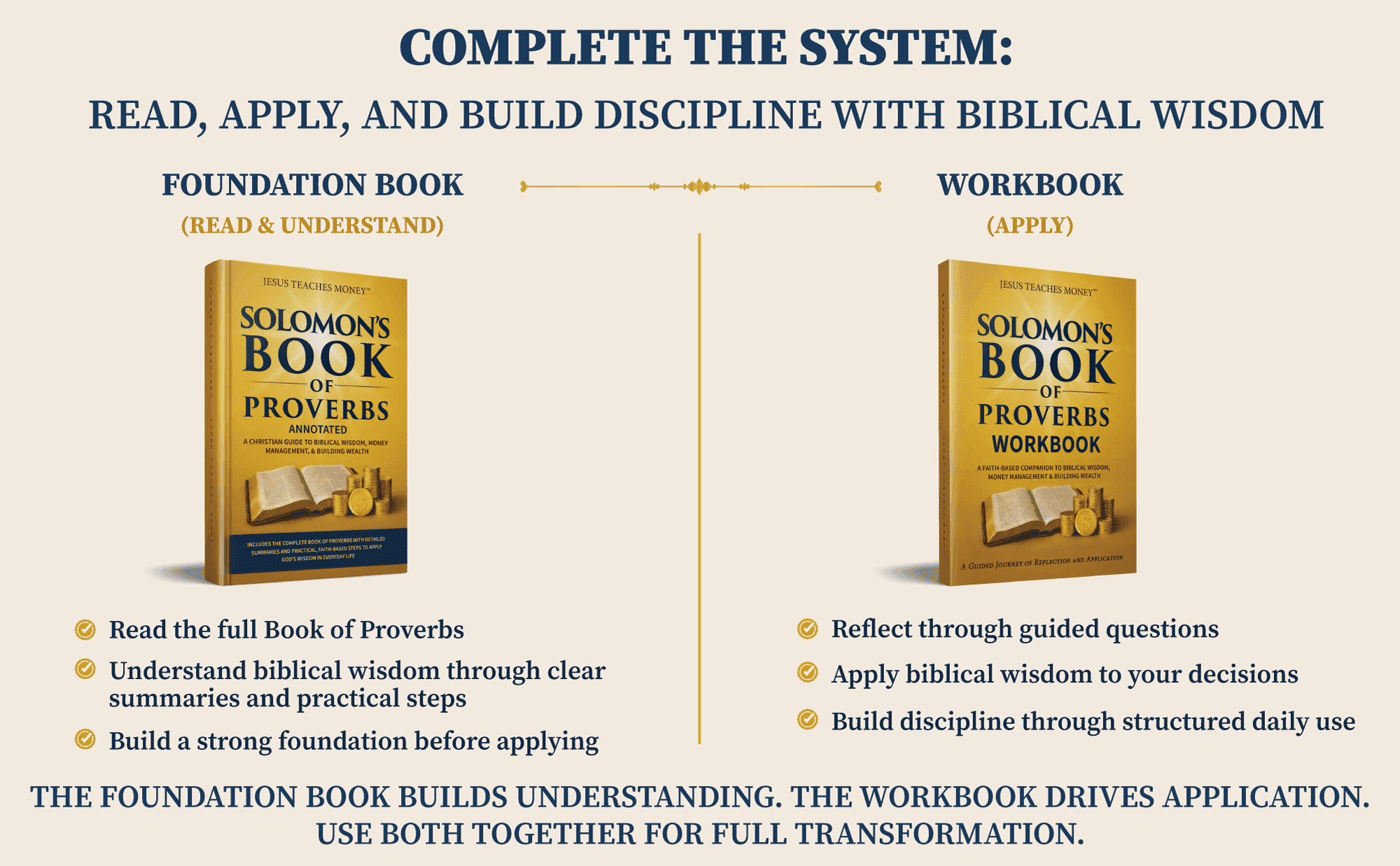
👉 Explore the 31-Day Proverbs Wealth System
Final Thoughts
Proverbs 4:23 makes a claim that is easy to acknowledge and difficult to take seriously: life is shaped from the inside out. What controls your heart controls your direction. When you guard your thoughts, your influences, and your priorities with biblical wisdom and apply that wisdom consistently, you begin building the kind of stability and clarity that external strategies alone cannot produce.
About the Author
Abraham Duncan is the author of Solomon's Book of Proverbs (Annotated) and the creator of the Jesus Teaches Money™ framework, a structured system designed to help Christians apply biblical wisdom to daily life, stewardship, and financial decision-making.
FAQs
What does Proverbs 4:23 mean?
It means that your inner life, your thoughts, motives, emotions, desires, and the influences you allow, shapes your external life. The direction of your decisions and habits flows from the condition of your heart.
How does this apply to money?
Financial habits frequently reflect what is happening internally. Emotional spending, impulsive decisions, comparison-driven behavior, and chronic lack of discipline usually begin in the heart before they appear in the bank account.
What is the first step I should take?
Identify one influence that is consistently shaping your thinking or financial behavior in a negative direction, and replace it with one specific, disciplined biblical habit this week.