
Table of Contents
- Direct Answer
- What Does Proverbs 21:20 Mean?
- Why Most People Do Not Save Consistently
- The Danger of Consuming Everything You Have
- How the Bible's Teaching on Saving Applies to Your
- Money
- A Practical Next Step
- Common Mistakes Christians Make About Saving
- Related Biblical Principles
- Apply Biblical Wisdom Consistently
- Final Thoughts
- About the Author
- FAQs
Direct Answer
What does the Bible say about saving money? Scripture treats saving not as a financial strategy but as a mark of wisdom and a discipline that flows from how a person governs themselves. Proverbs 21:20 states plainly that the wise store up resources while the foolish consume everything they have. Saving, in the biblical framework, is not about accumulating wealth for its own sake. It is about building the kind of margin that allows you to live generously, respond to uncertainty, and make decisions from a position of strength rather than desperation.
What Does Proverbs 21:20 Mean?
Proverbs makes the principle direct:
"Precious treasure and oil are in the house of the wise, but a foolish man devours it." (Proverbs 21:20, Berean Standard Bible)
The contrast here is not between rich and poor. It is between wise and foolish. The wise person has resources stored up, not because they earned more, but because they consistently chose to keep some of what they earned. The foolish person consumes everything available, regardless of how much comes in.
This distinction matters because it removes income as the primary variable. The issue Proverbs identifies is not how much you make. It is what you do with what you have. A person with a modest income who saves consistently is described as wise. A person with significant income who spends everything is described as foolish. The behavior is what distinguishes them, not the amount.
The ant passage in Proverbs 6:6-8 reinforces this from a different angle. The ant stores provisions in summer, prepares during harvest, and does so without being told, supervised, or motivated by external pressure. The lesson is not just about saving. It is about the internal discipline that produces saving without needing a crisis to prompt it.
Why Most People Do Not Save Consistently
The most common explanation for not saving is that there is not enough money left after expenses. That is sometimes true. But for most people, the real explanation is that spending expands to fill whatever income is available, and saving is treated as what happens with the remainder rather than as a deliberate first decision.
That pattern is precisely what Proverbs warns against. The foolish person in Proverbs 21:20 does not save because consumption is the default. Every dollar that arrives is already spoken for, not by genuine need but by accumulated habit, convenience spending, and lifestyle inflation that crept in gradually and was never examined.
The deeper problem is that most people do not associate their spending behavior with their character. Spending feels like a response to circumstances. Proverbs frames it differently: how you handle money reveals the condition of your internal discipline. Consistent overconsumption is not bad luck. It is a pattern that reflects what is actually governing your decisions.
The Danger of Consuming Everything You Have
An unexamined consumption pattern does not stay neutral. It compounds.
When there is no margin in a budget, every unexpected expense becomes a crisis. Every opportunity that requires capital cannot be taken. Every financial decision is made from pressure rather than from wisdom, because there is no buffer between you and the next disruption.
More significantly, the absence of savings narrows generosity. You cannot give freely from what you do not have. You cannot help others in need when you have no reserves. You cannot honor God with your resources when those resources are already consumed before the need arises.
Proverbs treats this as a foreseeable consequence of foolishness, not as bad fortune. The person who devours everything in Proverbs 21:20 is not a victim of circumstances. They made a series of choices, most of them small and unremarkable, that left them with nothing stored up when it mattered.
How the Bible's Teaching on Saving Applies to Your
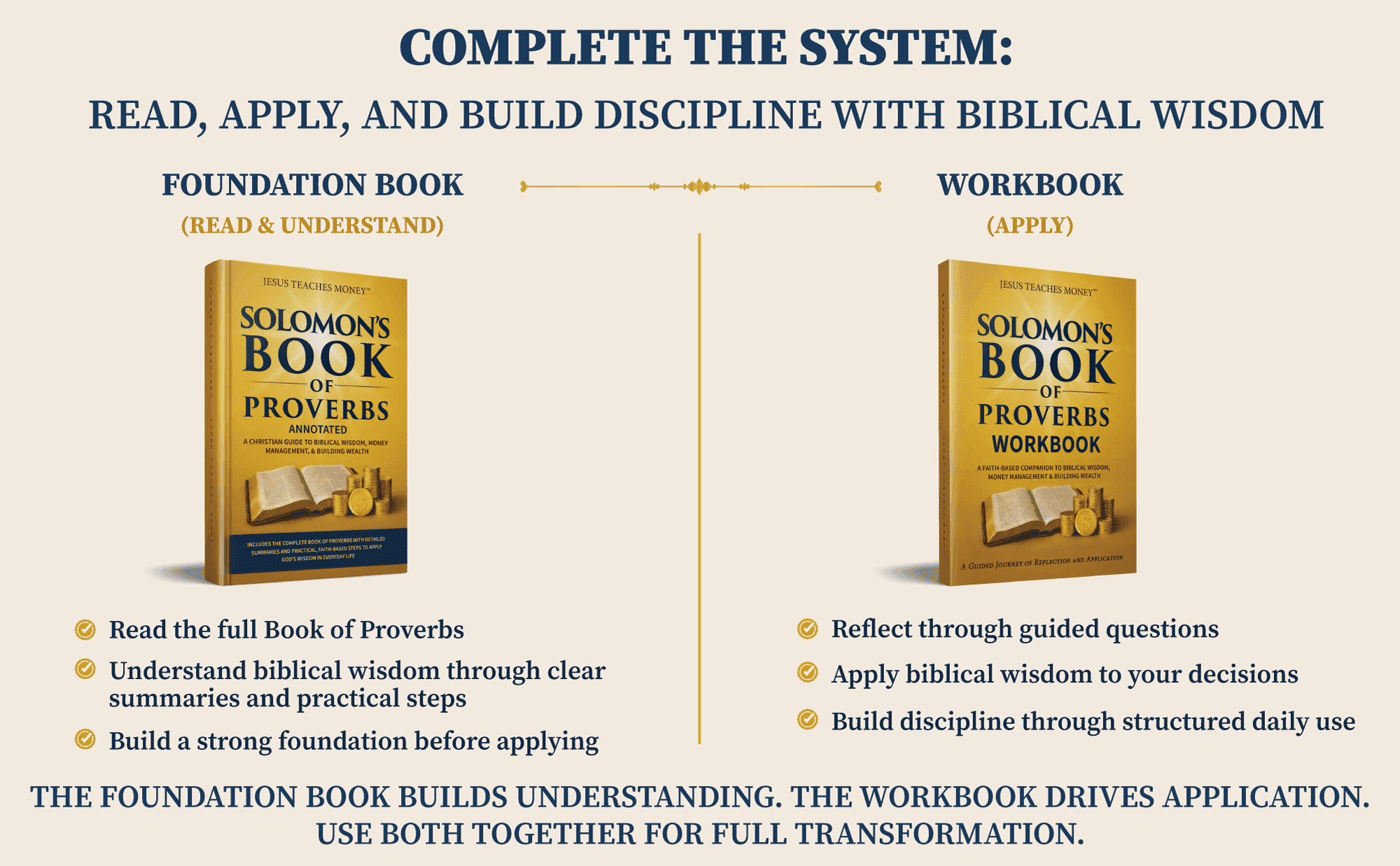
Jesus Teaches Money™: 31-Day Proverbs Wealth System (Book & Workbook Digital Bundle)
$39.97
Apply Biblical Wisdom in Your Daily Life in 31 Days A structured Proverbs-based system designed to move you from reading Scripture to disciplined, consistent application in your daily decisions, strengthening your stewardship and improving your financial direction. Includes an annotated… read more

Money
What the Bible says about saving money has direct, practical implications for how you structure your financial decisions.
The first principle is that saving is a decision made before spending, not after. The ant does not save what is left over after the summer. It stores provisions during the harvest, before the need arrives. Applied practically, this means a portion of every dollar that comes in is directed toward savings before discretionary spending begins. That single shift changes the structure of a budget more than almost any other adjustment.
The second principle is that saving is a long-term discipline, not a short-term reaction. People frequently save when they are frightened and stop when stability returns. Proverbs describes the wise person as someone who maintains the habit regardless of season or circumstance, not because they are responding to fear but because discipline is their normal operating mode.
The third principle is that saving serves a purpose beyond the account balance. Biblical saving is not hoarding. It is building the capacity to be generous, to handle disruption without panic, and to make decisions from wisdom rather than urgency. The goal of storing up is not wealth accumulation as an end. It is stewardship that positions you to live and give well.
A Practical Next Step
Applying what the Bible says about saving money does not require a large income or a perfect budget. It requires one decision, made consistently.
- Identify a specific percentage of your income, even if it is small, and commit to saving it before any discretionary spending begins this week. Start with what is realistic, not with what is ideal.
- Open a separate account dedicated to savings if you do not already have one. Keeping savings separate from spending removes the temptation to consume it.
- Treat this amount as a non-negotiable decision, not a monthly intention. Intentions without structure do not produce savings. Decisions made in advance do.
The ant in Proverbs does not deliberate during every harvest. The habit is already established. Build the structure so the decision does not have to be made again each month.
Common Mistakes Christians Make About Saving
Treating Saving as Optional Until Income Increases
Most people plan to save more when they earn more. Proverbs does not support that logic. The foolish person in Proverbs 21:20 devours what they have, not what they wish they had. The pattern of consumption does not change automatically with income; it has to be deliberately interrupted at whatever level you are currently at.
Confusing Saving With Hoarding
Hoarding is accumulation driven by fear and self-protection. Saving, as Scripture describes it, is disciplined stewardship that enables generosity and wise decision-making. The distinction is in the motive and the use. Biblical saving builds capacity for others; hoarding closes it off.
Saving Without a Purpose
Savings without a defined purpose tend to get consumed when spending pressure rises. Knowing why you are saving, whether for generosity, emergency margin, a future obligation, or a specific need, gives the discipline a concrete anchor that is easier to protect.
Starting Too Late Because the Amount Feels Too Small
The ant does not wait for a larger harvest to begin storing. Consistent small amounts saved over time outperform inconsistent large amounts saved occasionally. Beginning with what you have now is the principle Proverbs consistently reinforces.
Related Biblical Principles
Several passages connect directly to what the Bible teaches about saving and financial discipline. Proverbs 6:6-8 uses the ant as a model of self-initiated preparation, building reserves without external pressure or supervision. Proverbs 13:11 establishes that wealth gathered little by little grows, while anything grabbed quickly tends to disappear, which is the compounding logic behind consistent saving. And the broader framework of applying these principles daily is worth examining through a step-by-step system for applying biblical wisdom to your life and finances.
Apply Biblical Wisdom Consistently
Knowing what Scripture teaches about saving is the beginning; building the daily discipline to act on it is where transformation actually happens.
👉 Explore the 31-Day Proverbs Wealth System
Final Thoughts
What the Bible says about saving money is consistent and clear: wisdom stores up, foolishness consumes. That is not a call to fearful hoarding or obsessive accumulation. It is a call to the kind of disciplined, purposeful stewardship that builds margin, enables generosity, and positions you to make decisions from wisdom rather than from pressure. The discipline starts small. The ant is not impressive in any single day. It is consistent, and consistency is exactly what Proverbs commends.
About the Author
Abraham Duncan is the author of Solomon's Book of Proverbs (Annotated) and the creator of the Jesus Teaches Money™ framework, a structured system designed to help Christians apply biblical wisdom to daily life, stewardship, and financial decision-making.
FAQs
What does the Bible say about saving money?
Scripture treats saving as a mark of wisdom. Proverbs 21:20 states that the wise store up resources while the foolish consume everything they have. The Bible does not frame saving as a financial strategy but as a discipline that reflects how a person governs themselves and their resources over time.
What does Proverbs 21:20 mean about saving?
Proverbs 21:20 contrasts the wise person who stores up resources with the foolish person who devours everything available. The distinction is behavioral, not income-based. The wise save consistently as a habit; the foolish consume as a default. The verse identifies the pattern, not the amount, as what separates them.
How do I start saving money biblically?
Begin by saving a specific percentage of your income before discretionary spending begins, not from what is left over. Keep savings in a separate account. Treat the amount as a non-negotiable decision made in advance, not a monthly intention. Start with what is realistic now rather than waiting for income to increase.
Is saving money selfish according to the Bible?
No. Biblical saving is stewardship, not selfishness. Proverbs commends storing up resources because it builds the capacity to be generous, handle disruption without panic, and make decisions from wisdom rather than urgency. The goal is margin that serves others, not accumulation that protects only yourself.