
Table of Contents
- Direct Answer
- What Does Tithing Mean in the Bible?
- What Does the Bible Say About Tithing in the New Testament?
- Why Most Christians Struggle With Tithing
- Is Tithing Really 10%? What the Bible Actually Teaches
- What Does God Say About Tithing: The Deeper Principle
- A Practical Next Step
- Common Mistakes Christians Make About Tithing
- Related Biblical Principles
- Apply Biblical Wisdom Consistently
- Final Thoughts
- About the Author
- FAQs
Direct Answer
What does tithing mean in the Bible? Tithing is the practice of giving a tenth of your income or resources as an act of worship, obedience, and trust in God. It is rooted in the Old Testament, affirmed through the New Testament's broader call to generosity, and consistently presented in Scripture as a discipline that reflects where your heart and priorities actually are. Tithing is not a transaction. It is a declaration that what you have comes from God and belongs to him first.
What Does Tithing Mean in the Bible?
The word tithe comes from an Old English term meaning "one tenth." In Scripture, the tithe was a structured practice in which the people of Israel gave a tenth of their agricultural produce, livestock, and resources to support the Levitical priesthood, the temple, and those in need. The first clear reference appears in Genesis, where Abraham gives a tenth of everything to Melchizedek, the priest of God Most High, before the Mosaic law was ever established. That detail matters. Tithing predates the law, which means it is not merely a legal obligation. It is an expression of something deeper.
In Malachi 3:10, God speaks directly to a people who had withheld their tithes:
"Bring the whole tithe into the storehouse, that there may be food in my house. Test me in this, says the LORD Almighty, and see if I will not throw open the floodgates of heaven and pour out so much blessing that there will not be room enough to store it." (Malachi 3:10, Berean Standard Bible)
This is one of the few places in Scripture where God explicitly invites testing. The language is not transactional; it is relational. God is not selling blessing in exchange for ten percent. He is pointing to the posture of the heart behind the act, and to what consistent, faithful giving produces in a person over time.
What Does the Bible Say About Tithing in the New Testament?
The New Testament does not abolish the principle behind tithing. It deepens it. Jesus references tithing in Matthew 23:23, acknowledging the practice while redirecting attention to justice, mercy, and faithfulness as the weightier matters. Paul writes in 2 Corinthians 9:7 that each person should give what they have decided in their heart to give, not reluctantly or under compulsion, because God loves a cheerful giver. The standard does not shrink in the New Testament. It expands from a tenth toward a posture of wholehearted generosity.
This is where many Christians get stuck. They treat the tithe as an Old Testament rule and conclude that the New Testament frees them from it. What the New Testament actually does is raise the standard from obligation to willing surrender. The question is not whether ten percent is still the rule. The question is whether the condition of your heart reflects someone who holds their resources loosely and gives generously.
Why Most Christians Struggle With Tithing
The most honest explanation for why tithing is difficult is not theological. It is behavioral and emotional.
Money feels like security. Giving it away, even a structured percentage, triggers the fear that there will not be enough. That fear is not addressed by more income. It persists regardless of what someone earns, because it is rooted in trust, not in math. A person earning thirty thousand dollars who does not trust God with their finances will not suddenly tithe freely at three hundred thousand dollars. The pattern follows the heart, not the income level.
A second struggle is that most people treat their tithe as what is left after everything else is covered. When the mortgage, the car payment, the groceries, and the discretionary spending are done, whatever remains is what gets given. That sequence inverts the biblical framework entirely. Tithing in Scripture is a first-fruits principle. It comes off the top, before other spending begins, as a deliberate act that orders the rest of your financial decisions around the recognition that God is the source.
The third struggle is consistency. Many Christians give when they feel moved, when finances feel comfortable, or when a specific need is presented. That is not tithing. It is occasional generosity, which is valuable, but it is not the same discipline Scripture describes. The biblical tithe is structured and regular precisely because discipline that depends on emotion does not hold.
Is Tithing Really 10%? What the Bible Actually Teaches
This is one of the most searched questions about tithing, and the honest answer is that ten percent is the starting point Scripture establishes, not a ceiling.
The Old Testament tithe was actually multiple tithes: one for the Levites, one for national festivals, and a third-year tithe for the poor. The combined giving commanded under the law exceeded ten percent significantly. The New Testament does not reduce that to a number. It points toward a posture of radical generosity that grows as you grow in faith.
For practical purposes, ten percent is the biblical baseline. Starting there is consistent with what Scripture teaches. But the goal is not to hit a percentage and stop. The goal is to develop a giving discipline that reflects increasing trust, increasing generosity, and a decreasing grip on money as a source of security.
What Does God Say About Tithing: The Deeper Principle
God's concern in the tithing passages is never primarily about the money. It is about what your handling of money reveals about where your trust actually sits.
Jesus makes this explicit in Matthew 6:21: where your treasure is, there your heart will be also. This is not a metaphor. It is a diagnostic. Your giving patterns reveal your actual priorities more accurately than your stated beliefs. A person who claims to trust God but consistently withholds their tithe is living in a contradiction that Proverbs addresses directly. Honoring God with your wealth, as Proverbs 3:9 instructs, is not optional for someone who claims to follow him. It is the natural expression of a heart that has genuinely surrendered financial control.
Tithing biblical in its proper sense is less about the ten percent and more about what the ten percent represents: an acknowledgment that everything you have came from God, belongs to God, and is stewarded by you on his behalf.
A Practical Next Step
If you are not currently tithing, do not wait until your finances feel comfortable to start. They will not feel comfortable if the habit is never built.
- Calculate ten percent of your current income, whatever that income is.
- Decide where that tithe will go: your local church, a ministry, or a combination. Make the decision in advance, not in the moment.
- Set up an automatic transfer or giving schedule so the decision is made once and executed consistently, removing the monthly temptation to redirect those funds when finances feel tight.
- Start this month, not next month. The discipline builds trust over time, and trust does not start until the first act of obedience does.
Common Mistakes Christians Make About Tithing
Treating It as an Old Testament Rule That No Longer Applies
This position requires ignoring that Abraham tithed before the law existed, that Jesus affirmed the practice, and that the New Testament consistently elevates rather than reduces the standard of generosity. Tithing biblical in the full sense of the word is a pre-law, law, and post-law principle.
Giving What Is Left Rather Than What Comes First
When tithing is treated as what remains after spending, it will always be crowded out. The first-fruits principle in Scripture is not incidental. The order matters. Giving first reorders every other financial decision that follows it.
Mistaking Occasional Giving for Consistent Tithing
Responding generously to a specific need is not the same as a regular, structured tithe. Both are valuable, but they serve different spiritual and practical functions. The tithe builds discipline; occasional giving responds to opportunity.
Waiting for Finances to Improve Before Starting
There is no income level at which tithing becomes easy if the discipline was never built at lower levels. The practice itself builds the trust that makes it sustainable. Waiting for comfort before starting is waiting for something that the practice itself is designed to produce.
Related Biblical Principles
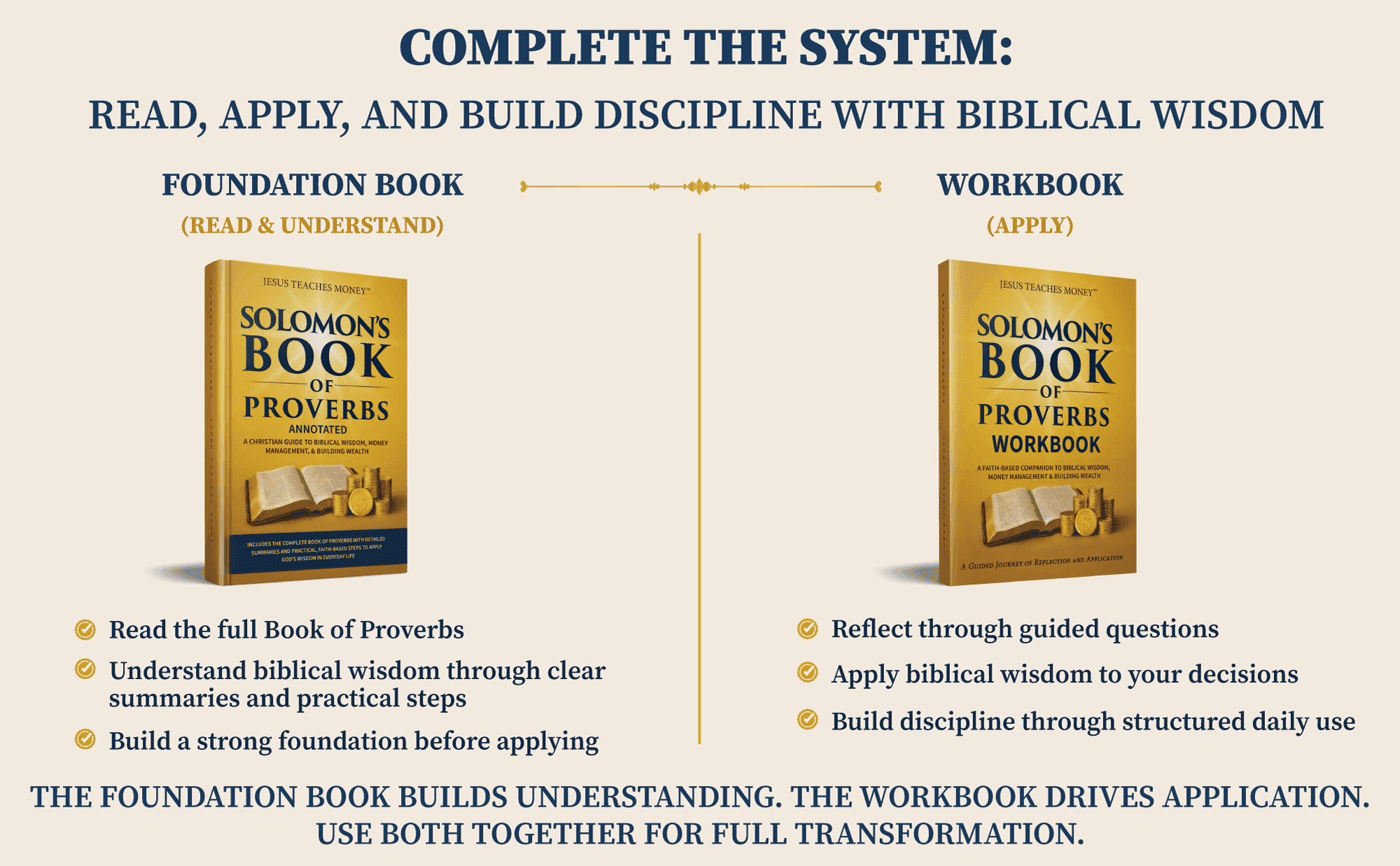
Several passages ground the broader picture of what tithing in the Bible represents within the larger framework of stewardship. Proverbs 3:9-10 instructs believers to honor God with their wealth and with the firstfruits of all their crops, connecting generosity directly to the order of financial priorities. Proverbs 11:24-25 teaches that one person gives freely and gains even more, while another withholds what is due and comes to poverty, which captures the counterintuitive logic of biblical generosity. The full framework for applying these principles consistently is laid out in the step-by-step system for applying biblical wisdom to your life and finances.
Apply Biblical Wisdom Consistently
Knowing what tithing means in the Bible is the beginning; building the daily disciplines of stewardship and generosity is where lasting transformation actually happens.
👉 Explore the 31-Day Proverbs Wealth System
Final Thoughts
What does tithing mean in the Bible? It means giving the first tenth of what you have as a structured act of worship, trust, and acknowledgment that God is the source of everything you own. It is not a tax, a transaction, or an Old Testament relic. It is a discipline that reveals and reshapes the condition of your heart toward money, generosity, and the God who provides. The ten percent is not the point. What it represents is.
About the Author
Abraham Duncan is the author of Solomon's Book of Proverbs (Annotated) and the creator of the Jesus Teaches Money™ framework, a structured system designed to help Christians apply biblical wisdom to daily life, stewardship, and financial decision-making.
FAQs
What does tithing mean in the Bible?
Tithing means giving a tenth of your income or resources as an act of worship, obedience, and trust in God. It is rooted in the Old Testament, affirmed in the New Testament, and consistently presented as a discipline that reflects where your priorities actually are. It is not a transaction. It is an act of surrender and acknowledgment that everything you have comes from God.
What does God say about tithing?
In Malachi 3:10, God invites believers to bring the full tithe and promises to open the floodgates of blessing in return. Jesus affirms tithing in Matthew 23:23 while pointing to justice, mercy, and faithfulness as the weightier matters. Paul calls for cheerful, decided giving in 2 Corinthians 9:7. Across both Testaments, God consistently connects generous giving to the condition of the heart.
Is tithing really 10%?
Ten percent is the baseline Scripture establishes, not a ceiling. The Old Testament actually included multiple tithes that exceeded ten percent combined. The New Testament raises the standard from a fixed percentage to a posture of wholehearted generosity that grows over time. Starting at ten percent is consistent with what the Bible teaches; the goal is increasing trust and generosity, not stopping at a number.
Is it a sin not to tithe?
Malachi 3:8 describes withholding the tithe as robbing God, which is the strongest language Scripture uses on the subject. The New Testament frames the issue less as rule-breaking and more as a heart condition: consistent withholding reveals misplaced trust and disordered priorities. Whether it is categorized as sin depends on your theological tradition, but Scripture is clear that consistent, structured generosity is not optional for someone who claims to follow God.
Jesus Teaches Money™: 31-Day Proverbs Wealth System (Book & Workbook Digital Bundle)
$39.97
Apply Biblical Wisdom in Your Daily Life in 31 Days A structured Proverbs-based system designed to move you from reading Scripture to disciplined, consistent application in your daily decisions, strengthening your stewardship and improving your financial direction. Includes an annotated… read more
